The quality of plastic finished products does not depend solely on machinery or processing parameters. Choosing the wrong material, poor moisture control, uneven mixing, or using additives at an incorrect dosage can reduce mechanical performance, cause surface defects, and increase scrap rates. Below are several critical mistakes related to plastic raw materials that manufacturers should pay close attention to.
1. Why do plastic raw materials directly affect finished product quality?
Raw materials form the foundation of many product properties, including stiffness, tensile strength, impact resistance, shrinkage, color, gloss, heat resistance, and service life. Machinery can control how the material melts and takes shape, but it cannot fully compensate for a resin that does not meet the product’s requirements.
For example, if a resin grade with low impact resistance is used for a component that is frequently exposed to mechanical stress, increasing injection pressure or processing temperature cannot turn it into a high-impact material. Likewise, once a polymer has degraded due to moisture or improper handling, adjusting machine settings alone is unlikely to restore its original properties.
Data from BASF for Ultramid B3S PA6 shows that moisture condition can significantly change the properties of the same material. The tensile modulus is reported at approximately 3,400 MPa in the dry state and around 1,200 MPa after moisture conditioning. Meanwhile, notched impact strength at 23°C increases from approximately 4 to 50 kJ/m².
Source: BASF – Ultramid B3S
In production, if a previously stable production line begins showing defects immediately after a material lot change, the raw material should be among the first factors to investigate. Warning signs may include color variation, black specks, bubbles, silver streaks, increased brittleness, or a sudden rise in scrap rates.
However, one defect can have multiple causes. Therefore, manufacturers should evaluate raw materials – formulation – processing conditions – machinery – mold together instead of drawing conclusions based on appearance alone.
2. Mistake 1: Choosing the wrong type or grade of plastic raw material
One of the most serious mistakes is selecting the correct polymer family but the wrong material grade. PP is still PP, but a grade designed for film, a grade for pipes, and a grade for thin-wall injection molding may have very different melt flow rates and mechanical properties.
SABIC data clearly illustrates this difference:
| PP grade |
Melt flow rate |
Typical application |
| SABIC PP 531Ph |
0.3 g/10 min |
Pipe and sheet extrusion |
| SABIC PP 524P |
2.0 g/10 min |
BOPP film |
| SABIC PP 575P |
11 g/10 min |
Injection molding |
| SABIC PP FPH50 |
50 g/10 min |
Thin-wall packaging, closures |
Source: SABIC – PP product portfolio
The lowest and highest values in this example differ by more than 160 times. This shows why asking “What is the melt flow rate of PP?” is not enough. The correct question is which PP grade is being used, for which processing method, and for which end product.
MFI or MFR is commonly used to evaluate the flow behavior of molten plastic under specified test conditions. According to ASTM D1238, this measurement is useful for quality control, but it does not represent the full performance of a polymer.
Source: ASTM D1238
Under the same test conditions, a higher MFI generally indicates easier flow. This can be advantageous for thin-wall products or parts with long flow paths. However, switching to a higher-MFI resin simply to solve poor mold filling can also change shrinkage, toughness, or other mechanical properties. Before changing the material, manufacturers should also check melt temperature, injection speed, pressure, gate size, and mold venting.
In addition to processability, the raw material must meet the actual service requirements of the product. Outdoor products may require UV resistance; packaging may require transparency, toughness, or food-contact compliance; technical components may need heat resistance, dimensional stability, or impact performance.
Therefore, material selection should follow this sequence:
Finished product requirements → production technology → required properties → material grade selection → trial run → evaluation.
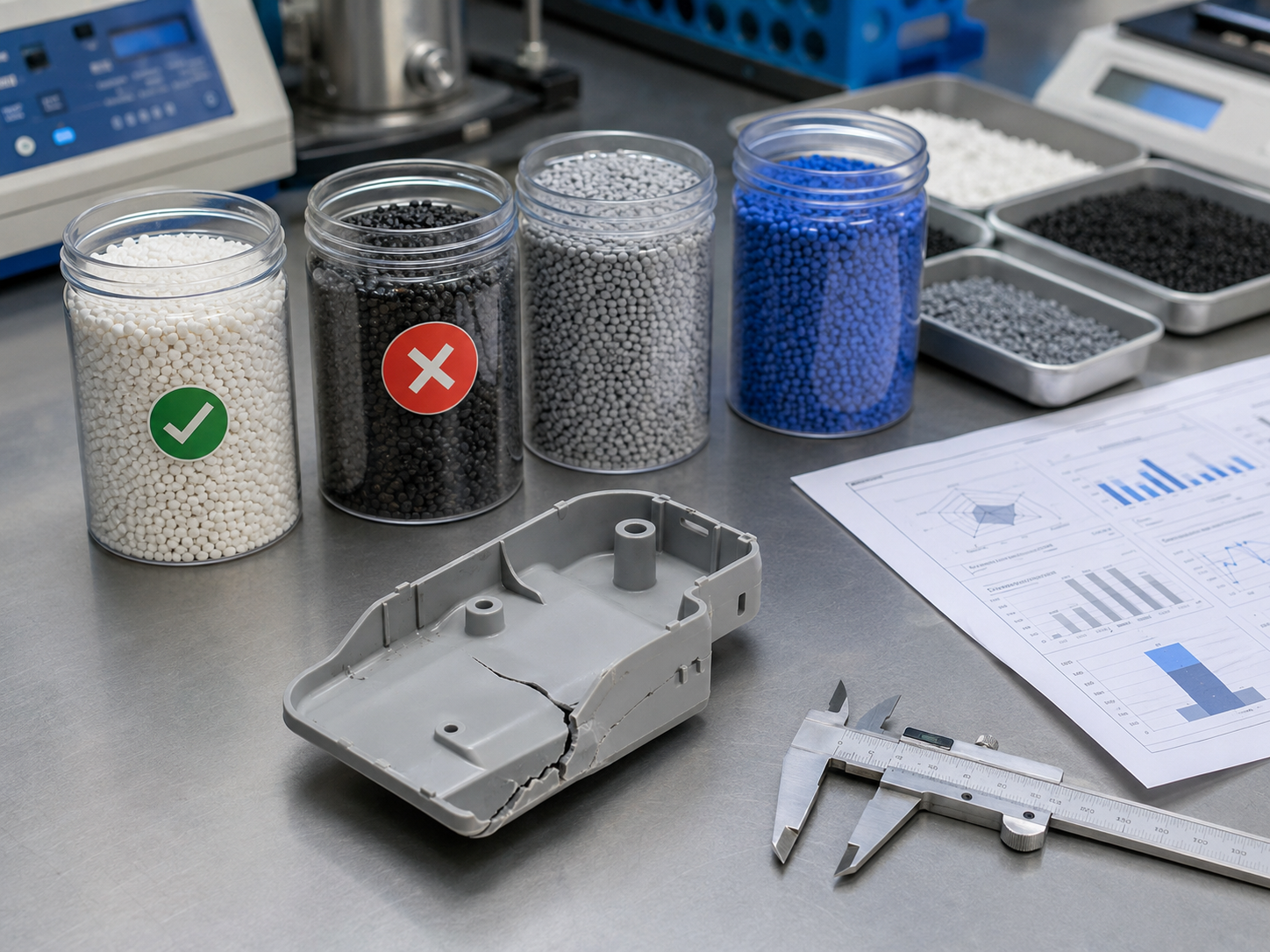
Different types of plastic raw materials and masterbatch used in production
3. Mistake 2: Failing to control moisture and dry the material properly
Plastic pellets can look completely dry while still containing enough moisture to affect processing. This is particularly important for moisture-sensitive polymers such as PA, PET, and PC.
Moisture limits can vary significantly between materials. BASF reports that Ultramid B3EG6 PA6 has a maximum moisture content of approximately 0.15%, while the recommended range for optimized surface quality and mechanical properties is 0.05–0.12%. A typical drying condition is approximately 2–4 hours at 83°C.
Source: BASF – Ultramid B3EG6
By comparison, Covestro specifies a maximum moisture content of 0.02% for Makrolon 2405 polycarbonate, with a recommended drying condition of approximately 120°C for 2–3 hours.
Source: Covestro – Makrolon 2405
These two limits differ by 7.5 times, which shows why the same drying conditions should not be applied to every plastic raw material.
Excess moisture may cause:
-
silver streaks on the surface;
-
bubbles or voids;
-
reduced transparency;
-
uneven surface appearance;
-
deterioration of mechanical properties in some polymers.
For polymers sensitive to hydrolysis, moisture can also reduce molecular weight during melting. In such cases, the product may still look acceptable while its strength has already declined.
Common drying mistakes include judging dryness by sight, focusing only on temperature while ignoring drying time, leaving dried material exposed to air for too long, or assuming that higher drying temperatures always produce better results.
When moisture-related problems are suspected, the entire sequence should be reviewed:
Initial moisture level → drying temperature → drying time → dryer condition → moisture after drying → waiting time before processing.
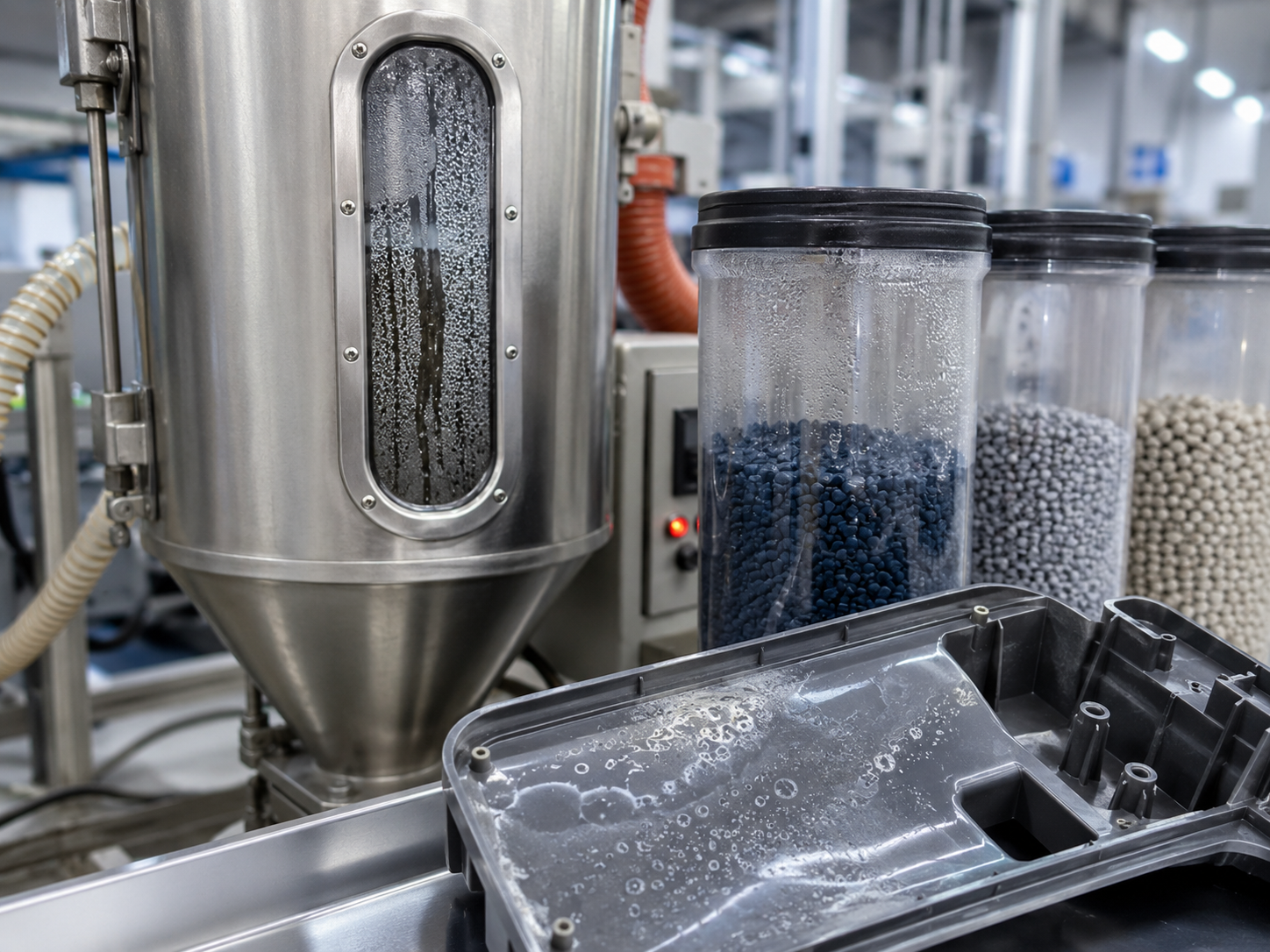
Moisture-contaminated plastic raw materials and common surface defects
4. Mistake 3: Allowing plastic raw materials to become contaminated or unevenly mixed
Even raw materials that meet specifications upon arrival can still cause production defects if they become contaminated during storage, internal transport, or feeding.
Common contamination sources include dust, other resin pellets, residual color masterbatch from a previous batch, degraded plastic inside the machine, oil, metal fragments, packaging debris, or poorly sorted recycled material. For white, light-colored, or transparent products, even a small amount of contamination can create visible defects.
Another issue is the accidental mixing of incompatible polymers. Not all thermoplastics can be blended directly simply because they all melt when heated.
Many polymer combinations have limited compatibility. When two phases do not bond well, the interface between them can become a weak point, reducing mechanical performance and material consistency.
A 2024 scientific review on the mechanical recycling of post-consumer plastics identified composition fluctuation and the presence of incompatible polymers as major challenges affecting the quality of recycled materials.
Source: Current Research in Green and Sustainable Chemistry
Uneven mixing can also occur when a formulation contains several components such as base resin, recycled resin, filler masterbatch, color masterbatch, and additive masterbatch. Even when the overall dosage is correct, poor distribution can still cause color variation, inconsistent mechanical properties, or uneven additive performance.
One important principle is: correct dosage does not necessarily mean good dispersion.
To reduce these risks, manufacturers should clearly separate materials in storage, clean hoppers and feeding lines when changing materials, control formulation ratios, and retain samples from important lots. If defects appear immediately after a lot change, retained samples can help identify the cause much faster than changing multiple machine parameters at once.
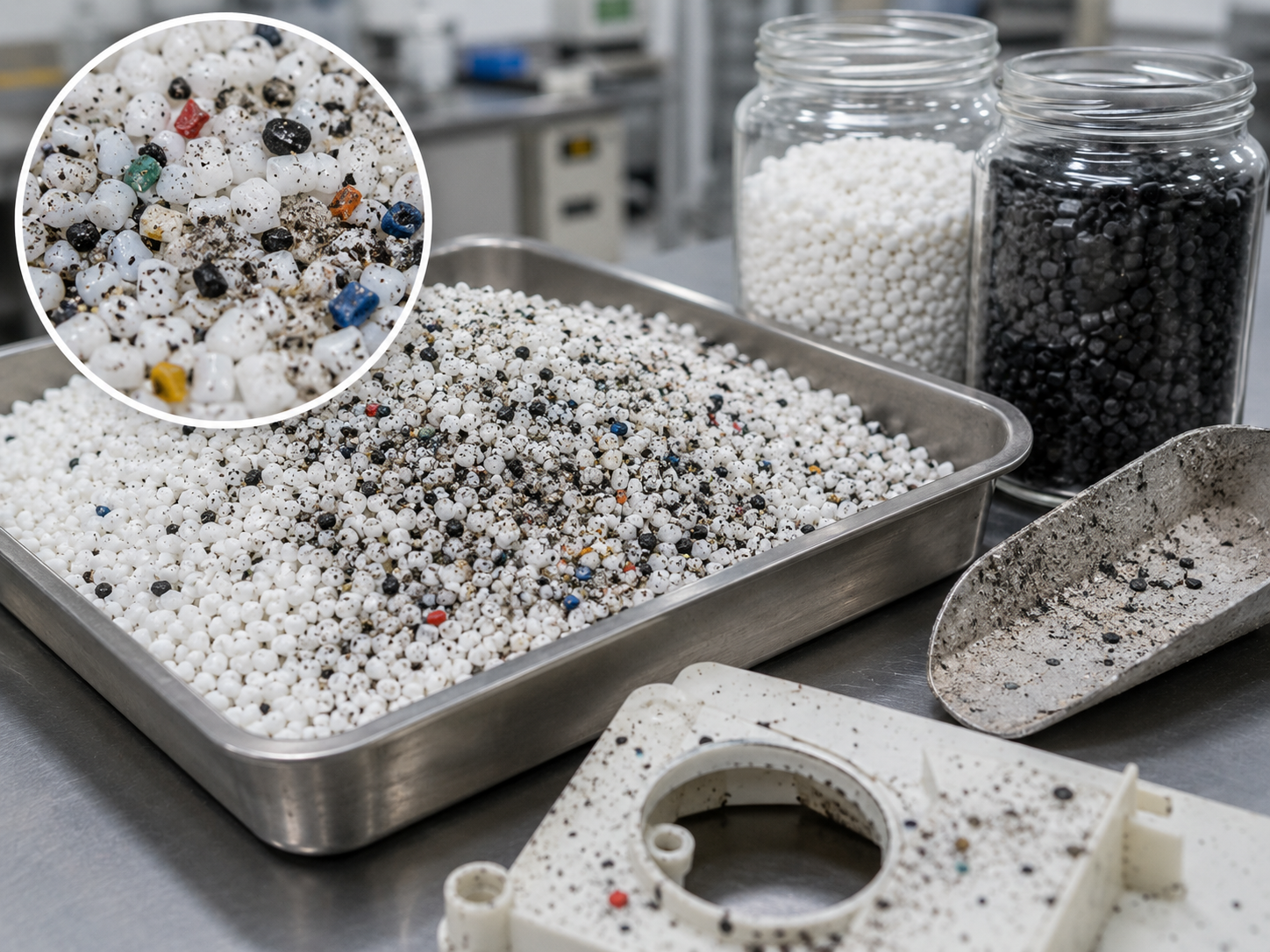
Allowing plastic raw materials to become contaminated or unevenly mixed
Note: The technical parameters cited above apply to specific material grades and should be used for reference only. In actual production, always check the technical data sheet of the exact material grade and confirm suitability under your own processing conditions.
5. Mistake 4: Using the wrong masterbatch or additive type or dosage
Masterbatch makes it easier and more consistent to introduce pigments, fillers, or additives into the base resin. However, its effectiveness depends on the masterbatch type, carrier resin, and dosage.
There is no single dosage that works for every material. For example, Cabot lists a typical use level of around 2–6% for its PLASBLAK PE4462 black masterbatch. However, this range applies only to that specific product and its intended applications, and should not be treated as a universal dosage for all black masterbatches.
Increasing the masterbatch dosage does not always lead to better results. An excessive dosage may alter the formulation, increase costs, or affect certain finished-product properties. On the other hand, an insufficient dosage may result in inadequate color, opacity, or additive performance.
With filler masterbatch, the effect of CaCO₃ should also be evaluated across multiple properties rather than only raw material cost.
A 2021 study published in the Journal of Composites Science evaluated PP containing 10–50% CaCO₃ by weight. When CaCO₃ content increased from 0 to 50%:
-
tensile modulus increased from 1.54 to 2.99 GPa, or approximately 94%;
-
tensile strength decreased from 32.1 to 20.4 MPa, or around 36%;
-
unnotched Izod impact strength decreased by nearly 89%.
Source: Journal of Composites Science – PP/CaCO₃ study
These results show why it is inaccurate to simply claim that filler always “increases” or “reduces” strength. In the same formulation, stiffness may increase significantly while tensile strength or impact resistance decreases. Particle size, surface treatment, carrier resin, and dispersion quality can all affect the final result.
Another factor that is often overlooked is compatibility between the masterbatch carrier resin and the base polymer. If they are not sufficiently compatible, problems such as poor dispersion, color variation, phase separation, or inconsistent mechanical properties may occur.
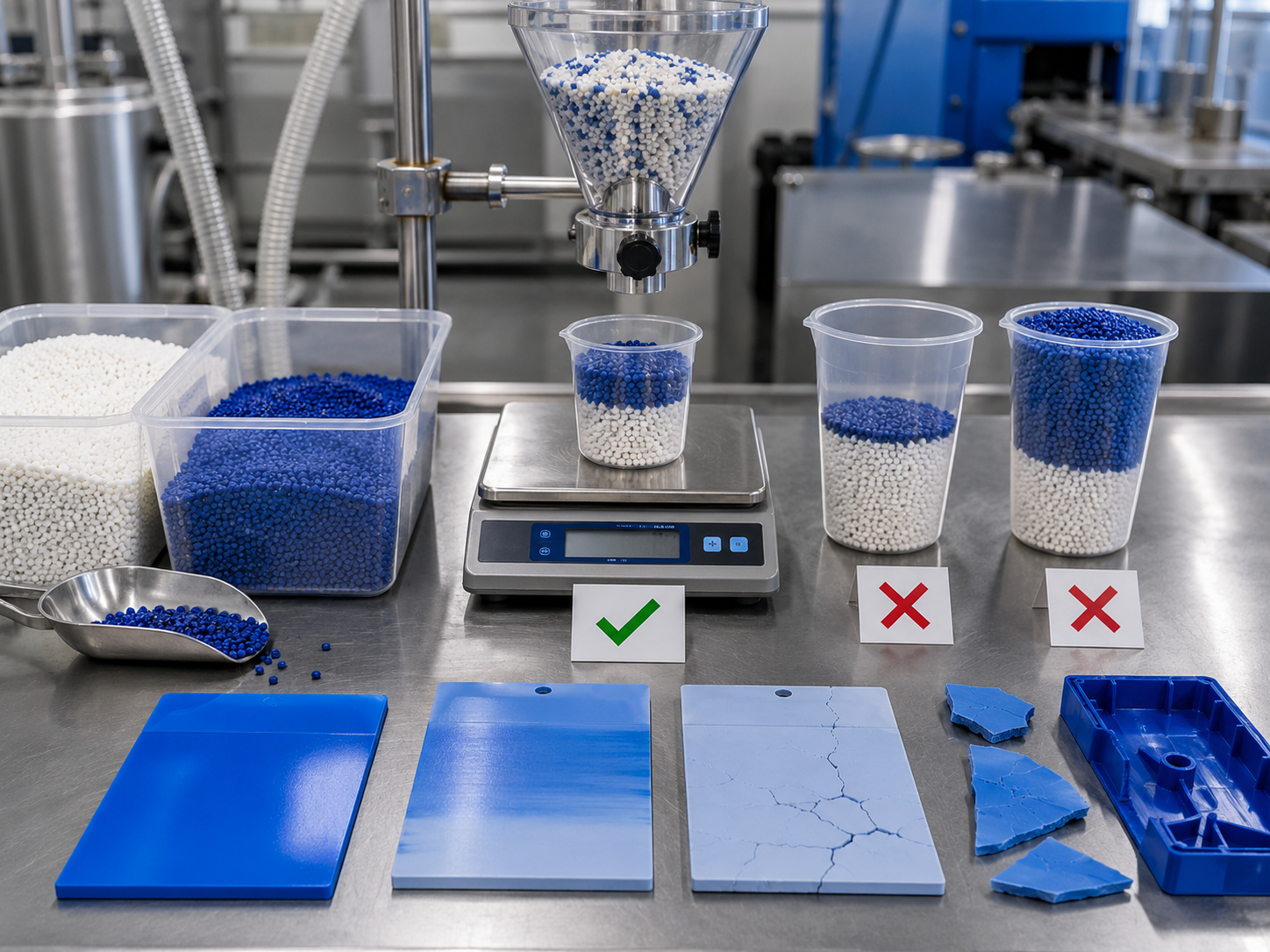
Therefore, an appropriate masterbatch dosage should be determined through the following process:
Identify the base resin → select a compatible masterbatch → refer to the recommended dosage → conduct a trial → test the finished product → adjust → standardize the formulation.
When evaluating effectiveness, manufacturers should not look only at raw material cost per kilogram. Scrap rate, product weight, cycle time, and the number of acceptable finished products should also be considered.
6. Mistake 5: Improper storage and management of plastic raw materials
Raw materials that meet specifications when they arrive at the factory can still change if they are stored incorrectly. Moisture, temperature, dust, packaging condition, and lot management can all affect material stability.
One often-overlooked risk is condensation. Covestro notes that when bags of raw material stored at a low temperature are moved into a warmer production environment, moisture may condense on the pellets. The material should therefore be allowed to reach the production-area temperature before the bag is opened.
Source: Covestro – Makrolon Processing Guide
Opened bags should also be properly resealed. For hygroscopic polymers, prolonged exposure to air can cause the material to absorb moisture again. Open packaging also increases the risk of contamination from dust, color pellets, or other materials.
Manufacturers should clearly record:
Lot management is particularly important when defects occur. Without traceability data, it can be difficult to determine which products were made from a problematic batch of material.
ASTM D8558-25 emphasizes the importance of tracing materials from their origin through manufacturing to the final product using reliable records and data.
Source: ASTM D8558-25
For storage, plastic raw materials should be kept in a clean, dry area, protected from direct sunlight, and not placed directly on the warehouse floor. Different materials should be clearly separated. Materials that have not yet been inspected or are waiting for disposition should also be isolated to prevent accidental use.
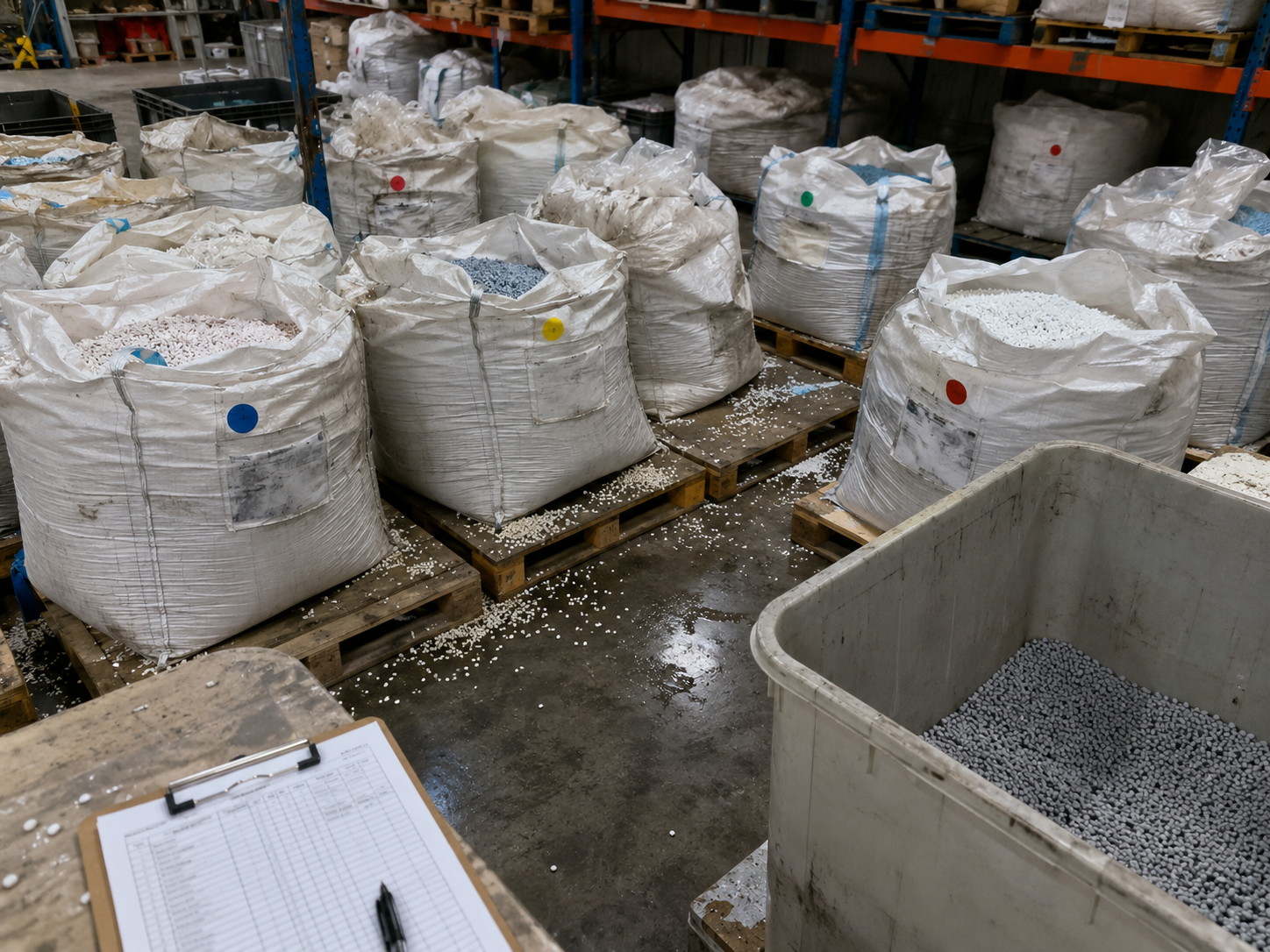
Improper storage and management of plastic raw materials
7. How can you tell whether a finished-product defect comes from the raw material?
A defect in the finished product can have several possible causes. The table below should therefore be used only as an initial troubleshooting guide:
| Finished-product defect |
Possible raw material-related cause |
| Brittle or easily cracked product |
Wrong material grade, degraded material, unsuitable filler dosage |
| Silver streaks or bubbles |
Excess moisture or volatile components |
| Uneven color |
Poor color masterbatch distribution or incorrect dosage |
| Black specks |
Contamination or degraded plastic |
| Warpage |
Unsuitable material shrinkage |
| Mechanical properties vary between lots |
Variation in formulation or raw material |
When a defect appears, check whether any change occurred immediately beforehand, such as a new raw material lot, a different supplier, a higher recycled resin ratio, a different masterbatch, or a change in drying conditions.
A practical rule is to change only one major variable at a time during troubleshooting. If temperature, injection speed, drying time, and formulation are all changed simultaneously, it becomes very difficult to identify the true cause.
When the material is suspected, manufacturers should retain a sample of the current lot, a sample of the defective product, and relevant production data. This information can also help the supplier provide more effective technical support.
8. Checklist for controlling plastic raw materials before production
A simple material-control procedure before starting the machine can significantly reduce the risk of using the wrong material or processing it in an unsuitable condition.
Before production, confirm that:
-
the correct polymer type and material grade are being used;
-
the correct lot number and formulation are selected;
-
the packaging is intact;
-
the material shows no signs of contamination;
-
moisture content is within the required limit;
-
the material has been dried correctly, if necessary;
-
the ratios of base resin, masterbatch, and recycled resin match the formulation;
-
the hopper, mixer, and feeding lines have been cleaned;
-
the dosing equipment is operating consistently.
When introducing a new material grade, a new supplier, or a new blending ratio, a production trial should be carried out before full-scale manufacturing.
Depending on the application, the evaluation may include:
More importantly, manufacturers should define acceptance and rejection criteria in advance rather than relying only on visual judgment.
9. 5 plastic raw material mistakes to avoid: Quick summary
| Mistake |
Main impact |
How to prevent it |
| Choosing the wrong material grade |
Poor processing, insufficient mechanical properties |
Select according to processing method and application |
| Failing to control moisture |
Bubbles, silver streaks, polymer degradation |
Dry according to the requirements of each material |
| Contamination or uneven mixing |
Color variation, inconsistent mechanical properties |
Clean equipment and control dosing accurately |
| Wrong masterbatch or dosage |
Unstable finished-product properties |
Conduct trials and validate the formulation |
| Improper storage |
Moisture absorption, contamination, poor traceability |
Manage warehouse conditions and lot numbers carefully |
In short, plastic raw materials must not only be the right type, but also the right grade, in the right condition, at the right dosage, and properly controlled throughout production.
10. Frequently asked questions about plastic raw materials
What are the signs that plastic raw materials contain too much moisture?
Silver streaks, bubbles, or abnormal surface appearance may be related to moisture. However, visual defects alone are not enough to confirm the cause. Moisture level and drying conditions should also be checked.
Is a higher MFI always better?
No. The appropriate MFI depends on the polymer, processing method, and product design. A higher MFI generally indicates easier flow under the same test conditions, but it does not mean the material is better.
Can recycled plastic be mixed with virgin resin?
Yes, in many applications. However, the quality of the recycled resin, its dosage, and the requirements of the finished product must be controlled carefully.
Does filler masterbatch reduce product strength?
It depends on dosage, particle size, surface treatment, base polymer, and the required mechanical properties. Some properties may increase while others decrease.
What is the appropriate masterbatch dosage?
There is no universal dosage. Manufacturers should start with the supplier’s recommended range, then conduct trials and validate the result on the actual finished product.
11. Conclusion
Finished-product quality begins with controlling plastic raw materials before they enter the machine. Choosing the wrong resin grade, failing to control moisture, uneven mixing, incorrect masterbatch dosage, or improper storage can all make production less stable.
Instead of addressing defects only after products have already been manufactured, companies should establish material-control procedures from the beginning, keep records for each lot, and validate every material change through actual testing. This approach can help reduce scrap, maintain consistent quality, and control production costs more effectively.
Note: The technical parameters and data cited in this article refer to specific materials or studies. For actual production, always consult the technical data sheet of the exact material grade and confirm its suitability under your own processing conditions.
12. About EuroPlas
EuroPlas is a manufacturer and supplier of material solutions for the plastics industry, with a portfolio including filler masterbatch, color masterbatch, white masterbatch, black masterbatch, additive masterbatch, and engineering plastic compounds.
With large-scale production capabilities and an international distribution network, EuroPlas provides solutions tailored to different base resins, processing technologies, and finished-product requirements.
Contact EuroPlas for support in selecting suitable plastic raw materials and masterbatch solutions for your production needs.
Author: The EuroPlas Team