Calcium carbonate particle size can make a significant difference in plastic performance, even when the CaCO3 loading remains unchanged. Particle size can influence dispersion, stiffness, impact strength, surface quality, and processing behavior. Understanding these effects helps manufacturers select the right calcium carbonate filler, reduce production issues, and achieve more consistent product quality.
1. What is calcium carbonate particle size and how is it measured?
Calcium carbonate particle size describes the dimensions of CaCO3 particles used as mineral filler, usually expressed in micrometers (µm). However, particle quality cannot be evaluated from one average value alone. Particle size distribution, agglomeration, surface treatment, and dispersion behavior should also be considered.
Read more: What is filler masterbatch and how it is applied to your production?
1.1. What does calcium carbonate particle size mean?
In plastic manufacturing, calcium carbonate is ground or produced into fine particles before being incorporated into a polymer matrix. The size of these particles determines, in part, the total surface area available for interaction with the polymer.
Smaller particles generally provide a larger total surface area at the same filler loading. This can affect filler–polymer interactions, dispersion behavior, rheology, and ultimately the mechanical properties of the finished plastic.
However, manufacturers should distinguish between primary particle size and the size of particle agglomerates.
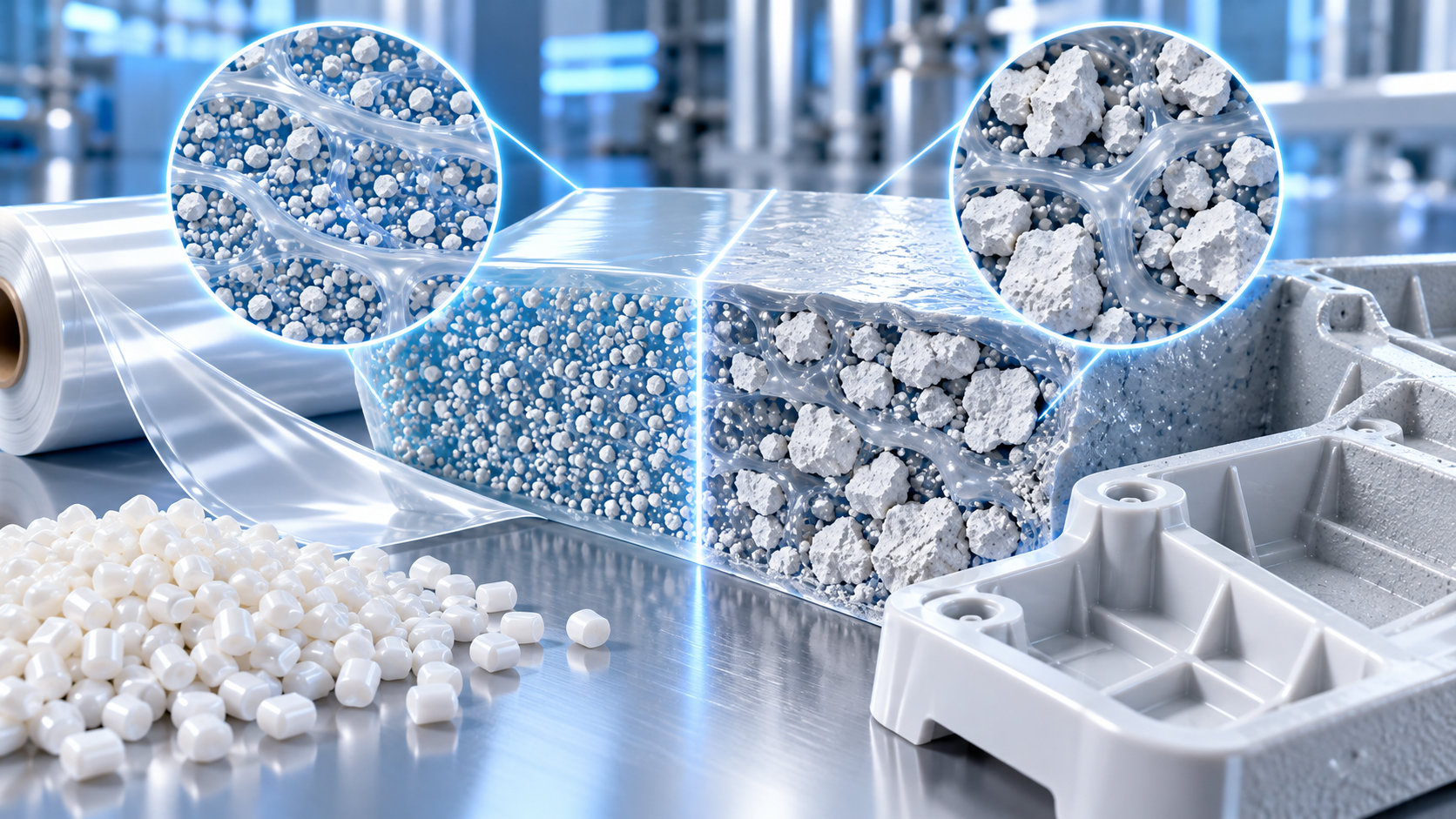
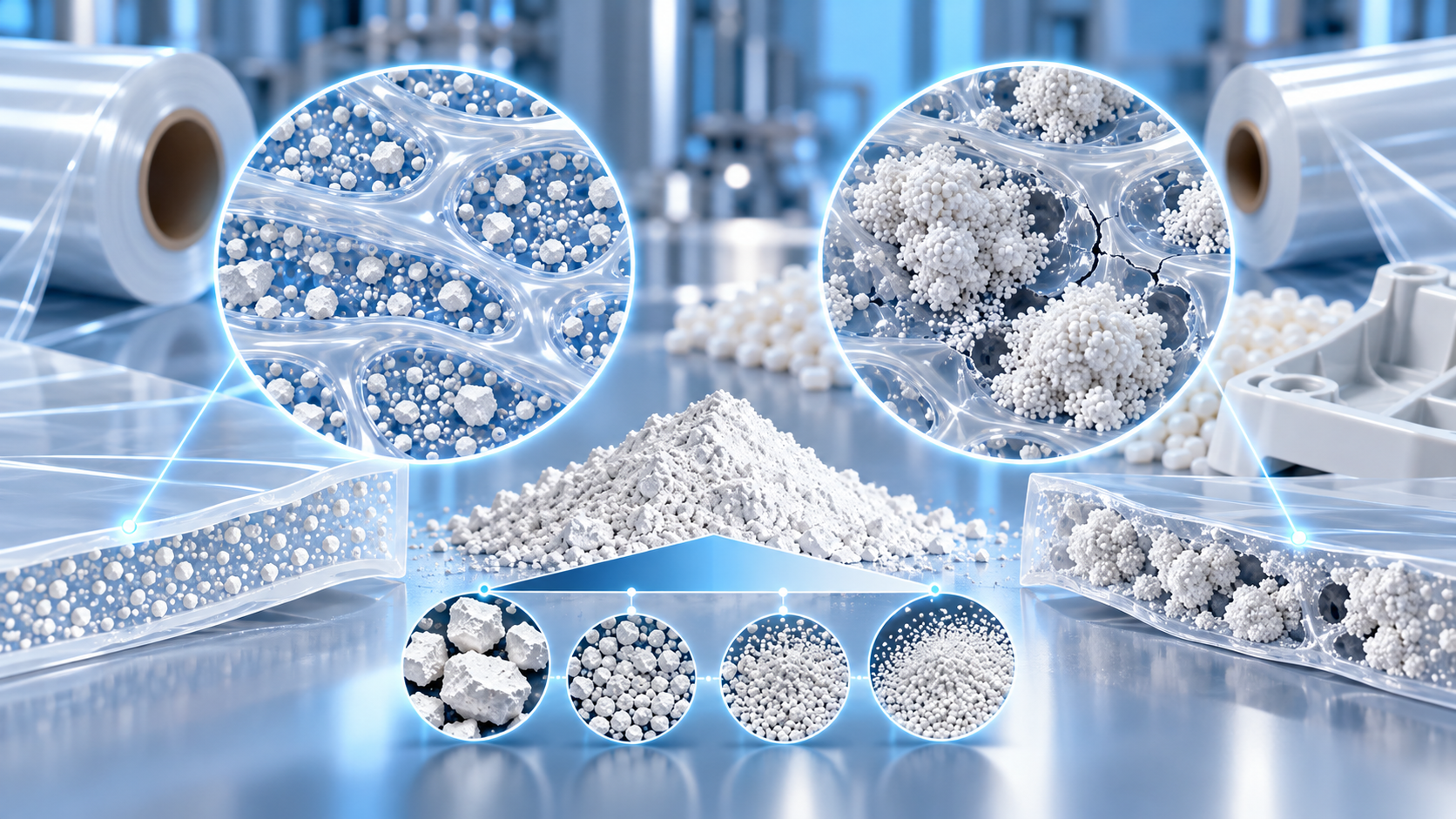
A calcium carbonate grade may contain very small primary particles, but if those particles are poorly dispersed, they can form much larger clusters. From the polymer's perspective, these clusters may behave like relatively large particles and create local defects in the material.
This is one reason why two calcium carbonate fillers with similar reported particle sizes may perform differently in the same plastic formulation.

1.2. What do D50, D90, and D97 mean for calcium carbonate?
D50 represents the particle size below which 50% of the measured particle distribution falls. D90 and D97 indicate the corresponding values for 90% and 97% of the distribution. Together, these parameters provide a clearer picture of the particle size distribution than D50 alone.
According to guidance from Malvern Panalytical, when particle size is reported by volume, Dv(50) is the diameter below which 50% of the sample volume is found. D90 follows the same principle for 90% of the measured volume.
For example, a calcium carbonate filler with D50 = 2 µm does not mean that every particle is 2 µm in diameter. The sample still contains both smaller and larger particles.
| Parameter |
Basic meaning |
Why it matters for CaCO3 |
| D50 |
Median particle size |
Indicates the central point of the particle size distribution |
| D90 |
90% of particles are below this value |
Helps evaluate the upper portion of the distribution |
| D97 |
97% of particles are below this value |
Useful for controlling coarse particles |
| Particle size distribution |
Full range of particle sizes |
Gives a more complete picture than D50 alone |
For plastic applications, D50 should therefore be reviewed together with D90, D97, and the overall particle size distribution (PSD) whenever this information is available.
1.3. Why is particle size not the only factor that determines CaCO3 performance?
Calcium carbonate particle size is important, but it works together with particle size distribution, surface treatment, purity, moisture, filler loading, dispersion quality, and the polymer matrix. A very fine CaCO3 grade can still perform poorly if it forms large agglomerates during processing.
In practice, calcium carbonate performance can be affected by:
- Particle size distribution.
- Particle morphology.
- Surface treatment.
- Filler dispersion.
- Compatibility with the polymer matrix.
- Moisture and impurities.
- Filler loading.
- Compounding and processing conditions.
This is also why many plastic processors use filler masterbatch rather than adding calcium carbonate powder directly to the production line.
In filler masterbatch, CaCO3 is pre-dispersed in a carrier resin with suitable additives to improve handling and support more consistent dispersion during processing.
Learn more about filler masterbatch and its applications.
2. How does calcium carbonate particle size affect plastic properties?
Calcium carbonate particle size can influence filler dispersion, impact strength, stiffness, tensile properties, surface quality, and processing behavior. However, the effect is not determined by particle size alone. Polymer type, filler loading, surface treatment, and compounding conditions all play important roles.
2.1. How does calcium carbonate particle size affect dispersion?
Smaller CaCO3 particles provide a larger surface area for interaction with the polymer, but finer particles may also show a stronger tendency to agglomerate. As particle size decreases, effective surface treatment and sufficient mixing become increasingly important for achieving uniform filler dispersion.
Dispersion is critical because calcium carbonate should be distributed as uniformly as possible throughout the polymer matrix.
When particles form large agglomerates, the material becomes less homogeneous. These clusters may act as local stress concentration points and can negatively affect mechanical performance.
Research on PP/CaCO3 composites published in Composites Part A has shown a clear relationship between particle dispersion, filler distribution, and impact behavior. Read the study on ScienceDirect.
For this reason, when a plastic compound shows poor mechanical performance, particle size should not be considered in isolation. Actual dispersion inside the polymer should also be evaluated.
2.2. How does calcium carbonate particle size affect impact strength?
In some polypropylene systems, smaller calcium carbonate particles can improve impact strength when dispersion and interfacial conditions are well controlled. However, the improvement does not necessarily continue as particle size decreases. Very fine particles that agglomerate may reduce the expected reinforcing or toughening effect.
A study by Kun Yang, Qi Yang, and Guangxian Li published in Polymer Composites compared calcium carbonate fillers with average particle sizes of 25 µm, 4 µm, 1.8 µm, and 0.07 µm in different polypropylene matrices.
The findings showed that both CaCO3 particle size and the inherent toughness of the polymer matrix significantly affected the mechanical behavior of the resulting composites. View the study from Wiley.
Another study on PP/CaCO3 composites found that stearic acid surface treatment and filler dispersion had a strong influence on impact strength, while larger agglomerates had an adverse effect. View the study on ScienceDirect.
These findings illustrate why the rule “smaller particles always produce stronger plastics” is not technically reliable.
2.3. How does calcium carbonate particle size affect stiffness?
Calcium carbonate is a rigid mineral filler, so adding it to many polymers can increase stiffness and modulus when the formulation is properly designed. However, the final effect depends on filler loading, particle size, polymer type, dispersion, and the interaction between the filler and the polymer matrix.
Higher stiffness can be useful for products that need improved dimensional stability, reduced deformation, or greater structural rigidity.
However, stiffness should not be optimized independently from toughness.
A formulation that provides very high stiffness but causes a substantial reduction in impact resistance or elongation may not meet the actual performance requirements of the finished product.
For this reason, manufacturers should evaluate calcium carbonate filler for plastics based on the complete performance profile of the compound rather than on stiffness alone.
2.4. How does calcium carbonate particle size affect tensile strength and elongation?
The effect of CaCO3 on tensile strength and elongation strongly depends on the interface between the filler and the polymer. Poorly dispersed particles or large agglomerates can behave as defects, reducing efficient stress transfer and potentially lowering the tensile performance of the material.
In a filled polymer system, stress must be transferred through the polymer matrix and around or across the mineral particles.
If filler–polymer adhesion is too weak, particles may separate from the matrix when the material is subjected to stress. At the same time, strong particle agglomeration can create weak regions where cracks are more likely to initiate.
As a result, two CaCO3 fillers with similar particle sizes but different surface treatments may produce noticeably different tensile properties.
2.5. How does calcium carbonate particle size affect surface quality?
A suitable particle size distribution combined with good dispersion can help maintain a more uniform plastic surface. In contrast, coarse particles or large CaCO3 agglomerates may create surface irregularities, visible defects, or processing issues, particularly in thin products.
This is especially important in blown films, thin-wall products, and applications where surface appearance is a key quality requirement.
In these cases, D50 alone may not provide enough information.
D97 can be particularly useful because it gives manufacturers an indication of the larger particles still present within the particle size distribution.
A low median particle size is not necessarily sufficient if the material still contains a relatively large coarse-particle fraction.
3. Is finer calcium carbonate always better for plastics?
No. Finer calcium carbonate can provide advantages in certain formulations, but smaller particle size does not automatically mean better plastic performance. As particle size decreases, surface area increases and dispersion becomes more demanding. Without proper surface treatment and mixing, very fine particles can agglomerate and reduce the expected benefits.
3.1. When can fine calcium carbonate be beneficial?
Fine calcium carbonate can offer advantages when the particles are well dispersed throughout the polymer.
At a fixed filler loading, reducing particle size generally increases the number of particles and total filler surface area. This can increase the number of interaction points between CaCO3 and the surrounding polymer.
In certain PP systems, studies have reported improvements in impact strength when the size of properly treated mineral filler particles was reduced.
For example, research published in Polymer Testing reported a relationship between reduced particle size of stearic-acid-treated calcium carbonate and improved impact performance under the specific experimental conditions. Read the study on ScienceDirect.
However, these findings should not be treated as a universal rule for PE, PVC, or all polypropylene applications.
3.2. Why can ultrafine calcium carbonate cause problems?
As calcium carbonate particles become finer, their total surface area increases and particle–particle interactions can become more significant. If the compounding system cannot sufficiently separate these particles, fine CaCO3 may remain in the polymer as agglomerates rather than as individual particles.
Research on polypropylene containing nanoscale calcium carbonate has shown that good dispersion can become more challenging as filler conditions change, illustrating the importance of considering both filler loading and particle size together. View the related study on ScienceDirect.
From a manufacturing perspective, this means that selecting a filler simply because it has a lower micron value is not enough.
The full formulation and the capability of the production line should also be considered.
3.3. Is there one ideal calcium carbonate particle size for every plastic?
No single calcium carbonate particle size is optimal for all plastic products. The suitable range depends on the polymer matrix, product thickness, processing technology, filler loading, surface treatment, and the required balance of mechanical and surface properties.
A particle size that works well in PP injection molding may not be suitable for PE blown film.
Likewise, PVC pipe, nonwoven products, woven packaging, and thin film all have different mechanical and processing requirements.
The most reliable approach is therefore to evaluate the filler within the actual formulation and production process.
4. How should calcium carbonate particle size be selected for different plastics?
Calcium carbonate particle size should be selected according to the performance requirements of the finished product rather than from a fixed micron value. As products become thinner or surface requirements become more demanding, control of particle size distribution and filler dispersion generally becomes increasingly important.
4.1. How should calcium carbonate be selected for PP?
For polypropylene, manufacturers usually need to balance stiffness, impact resistance, elongation, and processing behavior.
Injection-molded products may benefit from increased rigidity and dimensional stability, while woven products or nonwoven applications may place greater emphasis on tensile behavior and process stability.
Therefore, particle size should be evaluated together with the PP carrier resin, filler concentration, surface treatment, and recommended dosage.
EuroPlas provides PP filler masterbatch based on calcium carbonate, PP carrier resin, and suitable additives for applications including injection molding, extrusion, and woven packaging.
4.2. How should calcium carbonate be selected for PE film?
For PE film, good dispersion is often more important than simply choosing the finest available CaCO3 grade.
Thin films can be particularly sensitive to oversized particles and agglomerates because these may create weak points, surface defects, or processing instability.
When evaluating calcium carbonate filler for plastics used in PE blown film, manufacturers should consider:
- D50.
- D90 or D97.
- Particle size distribution.
- Surface treatment.
- Carrier resin.
- Filler dosage.
- Actual dispersion on the blown-film line.
Trial production is especially valuable when film thickness is reduced or filler loading is increased.

4.3. How should calcium carbonate be selected for PVC?
Calcium carbonate is widely used in PVC applications including pipes, profiles, sheets, and other extruded products.
Fine and properly treated CaCO3 may support surface quality and help modify mechanical properties, but higher filler loading or poor dispersion can still negatively affect the finished compound.
For this reason, calcium carbonate should be evaluated within the complete PVC formulation rather than treated as an isolated ingredient.
4.4. How do coarse, fine, and ultrafine CaCO3 particles compare?
| Property |
Relatively coarse particles |
Fine particles |
Very fine particles |
| Surface area |
Lower |
Higher |
Very high |
| Dispersion requirement |
Lower |
Higher |
Very high |
| Agglomeration risk |
Relatively lower |
Higher |
High if poorly controlled |
| Surface quality potential |
More limited |
Good with proper dispersion |
High potential but more demanding |
| Mixing requirement |
Lower |
Moderate to high |
High |
| Formulation sensitivity |
Lower |
Moderate |
High |
This comparison is intended as a general guide. Fixed micron ranges should not automatically be assigned to these categories because classifications may vary between suppliers and applications.
5. What other CaCO3 properties affect plastic performance?
In addition to calcium carbonate particle size, plastic performance can be influenced by surface treatment, particle size distribution, filler loading, purity, moisture, and compatibility with the polymer matrix. These factors can significantly change the performance of CaCO3 even when particle size remains similar.
5.1. Why is calcium carbonate surface treatment important?
Calcium carbonate has an inorganic surface, while polymers such as PP and PE are organic materials. Their natural interfacial compatibility is therefore limited.
Surface treatment can modify the characteristics of CaCO3 particles and help improve filler dispersion or interfacial behavior.
A study by Orkun Ersoy and Harun Köse at Hacettepe University found that composite properties were significantly influenced by both filler dispersion and surface treatment method. View the research record.
This is another reason why comparing CaCO3 grades solely on particle size can produce misleading conclusions.
5.2. Why does particle size distribution matter?
Two calcium carbonate products can have the same D50 but very different upper particle-size limits.
For example, a filler with D50 = 2 µm and D97 = 6 µm contains a substantially different coarse-particle fraction from another filler with D50 = 2 µm and D97 = 15 µm.
This difference may be particularly important in thin products or applications with strict surface-quality requirements.
Manufacturers should therefore evaluate both the median particle size and the upper end of the calcium carbonate particle size distribution.
5.3. How does filler loading affect CaCO3 performance?
Particle size cannot be evaluated independently from filler loading.
As the amount of CaCO3 increases, the average distance between filler particles decreases, making uniform dispersion more difficult.
A suitable filler loading should therefore be determined according to the required properties of the finished product.
Increasing calcium carbonate may help adjust stiffness and material cost, but excessive loading can adversely affect elongation, impact performance, and processing stability.
The same principle applies when selecting EuroPlas filler masterbatch: the recommended addition rate should be adjusted according to the polymer, processing technology, and final product requirements rather than treated as one universal formula.

6. How should manufacturers evaluate calcium carbonate before mass production?
Before changing a calcium carbonate grade or filler masterbatch, manufacturers should review technical data, run small-scale trials, and measure the key properties of the finished plastic. This approach is more reliable than selecting a filler based only on calcium carbonate particle size or raw-material cost.
6.1. Which CaCO3 specifications should be checked?
Depending on the application, manufacturers should consider checking:
- Calcium carbonate content.
- D50.
- D90 or D97.
- Particle size distribution.
- Whiteness.
- Moisture.
- Surface treatment.
- Density.
- Purity and impurities.
Not every supplier reports all of these values.
Where a parameter has a direct influence on the final application, manufacturers should request additional technical data or relevant test results when necessary.
6.2. Why should CaCO3 not be selected by D50 alone?
D50 represents only one point within the full particle size distribution.
It does not directly indicate the quantity of coarse particles, the degree of agglomeration, surface treatment quality, or compatibility with the polymer.
A calcium carbonate product with a lower D50 may therefore not necessarily perform better on a particular production line.
A more reliable evaluation combines raw-material specifications with testing of the final plastic product.
6.3. Which properties should be tested in the finished plastic?
Depending on application requirements, manufacturers may evaluate:
- Tensile strength.
- Elongation at break.
- Impact strength.
- Stiffness or modulus.
- Melt flow index.
- Surface quality.
- Filler dispersion.
- Shrinkage and dimensional stability.
- Processing stability.
Pilot trials are particularly important when changing CaCO3 suppliers, switching filler grades, increasing filler loading, reducing product thickness, or modifying the polymer matrix.

7. Conclusion
Calcium carbonate particle size is an important parameter, but it does not determine plastic quality on its own. Smaller CaCO3 particles can offer a larger filler–polymer interaction area and provide performance benefits in certain formulations, yet they also require better dispersion control and may show a greater tendency to agglomerate.
Instead of searching for one universally “best” particle size, manufacturers should evaluate D50, D90 or D97, overall particle size distribution, surface treatment, filler loading, polymer matrix, and processing conditions together.
Most importantly, any significant material change should be validated in the actual product and production process.
This approach provides a more reliable basis for balancing product performance, process stability, and material cost when selecting calcium carbonate filler for plastics.
8. About EUROPLAS
EUROPLAS is the plastic materials brand of European Plastic Joint Stock Company (EuP), one of the world’s leading filler masterbatch manufacturers. With 19 years of experience, EuP operates a network of seven manufacturing plants in Vietnam and Egypt, with a total production capacity of approximately 0.9 million tons per year and exports to more than 95 countries worldwide. In addition to filler masterbatch as its core product line, EuP offers a diversified portfolio of material solutions, including color masterbatch, additive masterbatch, engineering plastic compounds, bioplastic compounds, and bio fillers for a wide range of plastic manufacturing applications.
Within its filler masterbatch portfolio, EUROPLAS combines calcium carbonate with suitable carrier resins and additives to develop materials for applications such as blown film, injection molding, extrusion, woven packaging, and other plastic products.
Manufacturers can contact EUROPLAS to discuss polymer type, addition rate, processing conditions, and finished-product requirements in order to identify a suitable filler masterbatch solution.
9. FAQ
9.1. What unit is used to measure calcium carbonate particle size?
Calcium carbonate particle size for plastic applications is commonly expressed in micrometers (µm). Very fine or nanoscale particles may also be reported in nanometers. Manufacturers should evaluate D50 together with the full particle size distribution rather than relying only on one average size value.
9.2. What does D50 mean for calcium carbonate?
D50 is the median particle size of a distribution. When measured by volume, D50 = 2 µm means that 50% of the measured particle volume lies below or at 2 µm. It does not mean that every particle in the calcium carbonate sample has a diameter of 2 µm.
9.3. What does D97 mean for calcium carbonate?
D97 indicates the particle size below which approximately 97% of the measured distribution falls, depending on the reporting method. It is useful for evaluating the coarse end of the distribution and can be especially important in thin films or products with demanding surface requirements.
9.4. Is finer calcium carbonate always better?
No. Fine calcium carbonate provides a larger surface area and may improve certain properties when properly dispersed. However, finer particles can also be more difficult to disperse and may form agglomerates. Final performance therefore depends on particle size, surface treatment, polymer type, filler loading, and processing conditions.
9.5. Does CaCO3 particle size affect impact strength?
Yes. Research on polypropylene composites shows that CaCO3 particle size can significantly affect impact behavior. However, the result also depends on polymer toughness, surface treatment, filler concentration, and dispersion quality. Particle size should therefore not be evaluated as an independent factor.
9.6. Why do small calcium carbonate particles agglomerate?
As particle size decreases, total surface area increases and particle–particle interactions can become more significant. Without suitable surface treatment and sufficient mixing, fine particles may form larger clusters instead of remaining uniformly dispersed throughout the polymer.
9.7. Can calcium carbonate surface treatment improve dispersion?
Yes, appropriate surface treatment can modify CaCO3 surface characteristics and improve its compatibility or dispersion within certain polymers. However, the final effect depends on the treatment method, polymer matrix, formulation, filler loading, and processing conditions.
9.8. What calcium carbonate particle size should be used for PP?
There is no single CaCO3 particle size suitable for every polypropylene application. The appropriate filler should be selected according to the processing method and requirements for stiffness, impact strength, elongation, surface quality, and processability.
9.9. What calcium carbonate particle size is suitable for PE film?
For PE film, both particle size distribution and dispersion quality are important. Coarse particles or agglomerates can be problematic in thin film. Manufacturers should evaluate D50 together with D90 or D97, surface treatment, filler masterbatch quality, and actual blown-film performance.
9.10. Can filler masterbatch be selected based only on CaCO3 particle size?
No. Filler masterbatch should also be evaluated based on carrier resin, filler concentration, additives, dispersion, moisture, polymer compatibility, processing behavior, and the mechanical requirements of the finished product.
10. About the Author
EuP Technical Content Team
This article was prepared by the EuP Technical Content Team in collaboration with EuP's specialist team, based on knowledge and experience in plastic materials, masterbatch, additives, and engineering plastic compounds. EuP aims to provide clear and practical technical information to help manufacturers better understand material properties, potential applications, and key considerations when selecting plastic materials for production. The content draws on EuroPlas product information and published research in Polymer Composites, Polymer, Polymer Testing, and particle-size guidance from Malvern Panalytical.
The technical information provided is intended for reference. Calcium carbonate specifications, filler masterbatch dosage, and processing conditions should be validated according to the actual formulation, equipment, production process, and performance requirements of each application.