The quality of engineering plastics cannot be evaluated only by polymer type or pellet appearance. Two materials based on the same polymer, such as PP, ABS, PC, or PA, may perform very differently when their filler content, reinforcement system, or additives are changed.
For this reason, plastic quality testing plays an important role in material selection and quality control. Manufacturers typically assess several groups of properties, including mechanical strength, impact resistance, thermal behavior, abrasion resistance, heat deformation, flame resistance, and aging performance. Each test provides different information about the material. The results should therefore be interpreted together and compared with the actual requirements of the final product.
This article explains seven common plastic testing methods used to evaluate engineering plastics and what each test reveals about material performance.
Read more: What is compounding in polymer? Common types of polymer compounding
1. What does plastic quality testing include?
Plastic quality testing normally involves several tests rather than a single measurement. Each test evaluates a different aspect of material performance.
The seven main groups covered in this article are:
| Test group |
Typical tests |
What it evaluates |
| Mechanical testing |
Tensile strength, flexural strength, elongation |
Ability to withstand load and deformation |
| Impact testing |
Izod, Charpy |
Resistance to sudden impact |
| Thermal testing |
HDT, Vicat, thermal aging |
Behavior at elevated temperatures |
| Abrasion testing |
Wear caused by friction |
Resistance to surface wear |
| Heat deformation testing |
Deformation under heat and load |
Ability to retain shape |
| Flammability testing |
Ignition and burning behavior |
Response to a flame source |
| Aging testing |
Property changes over time |
Long-term material stability |
These plastic testing methods are covered by a range of international standards. For example, ISO 527-1:2019 provides general principles for determining tensile properties of plastics, ISO 178:2019 covers flexural properties, and ISO 180:2023 applies to Izod impact strength.
The most important point is that test results should be interpreted as a group. High stiffness does not automatically mean high impact resistance, just as good heat resistance does not necessarily indicate strong abrasion resistance.
For effective plastic material testing, the properties being measured should always reflect the operating conditions of the final product.
2. Mechanical testing of engineering plastics
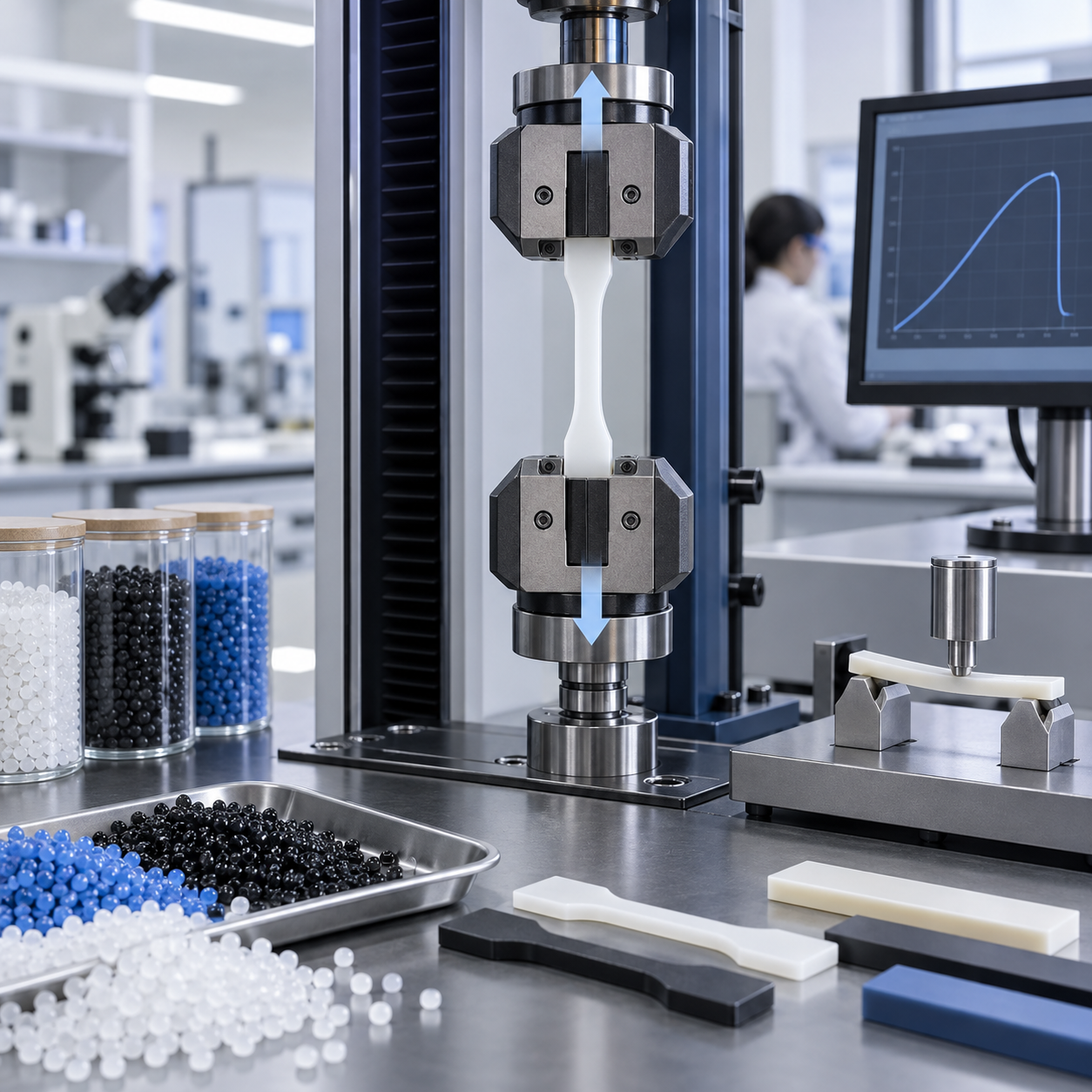
Mechanical testing evaluates how a plastic behaves when subjected to force. Three of the most commonly measured engineering plastics properties are tensile strength, flexural strength, and elongation.
-
Tensile strength describes the material's resistance to pulling forces.
-
Flexural strength indicates its ability to resist bending under load.
-
Elongation shows how much the material can deform before failure.
According to ISO 527-1:2019, tensile testing can be used to determine tensile strength, tensile modulus, and other characteristics of the stress–strain relationship. ISO 178:2019, meanwhile, covers the behavior of plastics under flexural loading.
In practice, the material with the highest strength value is not always the most suitable choice.
For example, a snap-fit component may need enough elongation to flex during assembly without cracking. A structural support, by contrast, may place greater emphasis on stiffness and resistance to bending.
This is why plastic quality testing should focus on the combination of properties required by the application rather than on a single maximum value.
3. Impact testing: Izod and Charpy
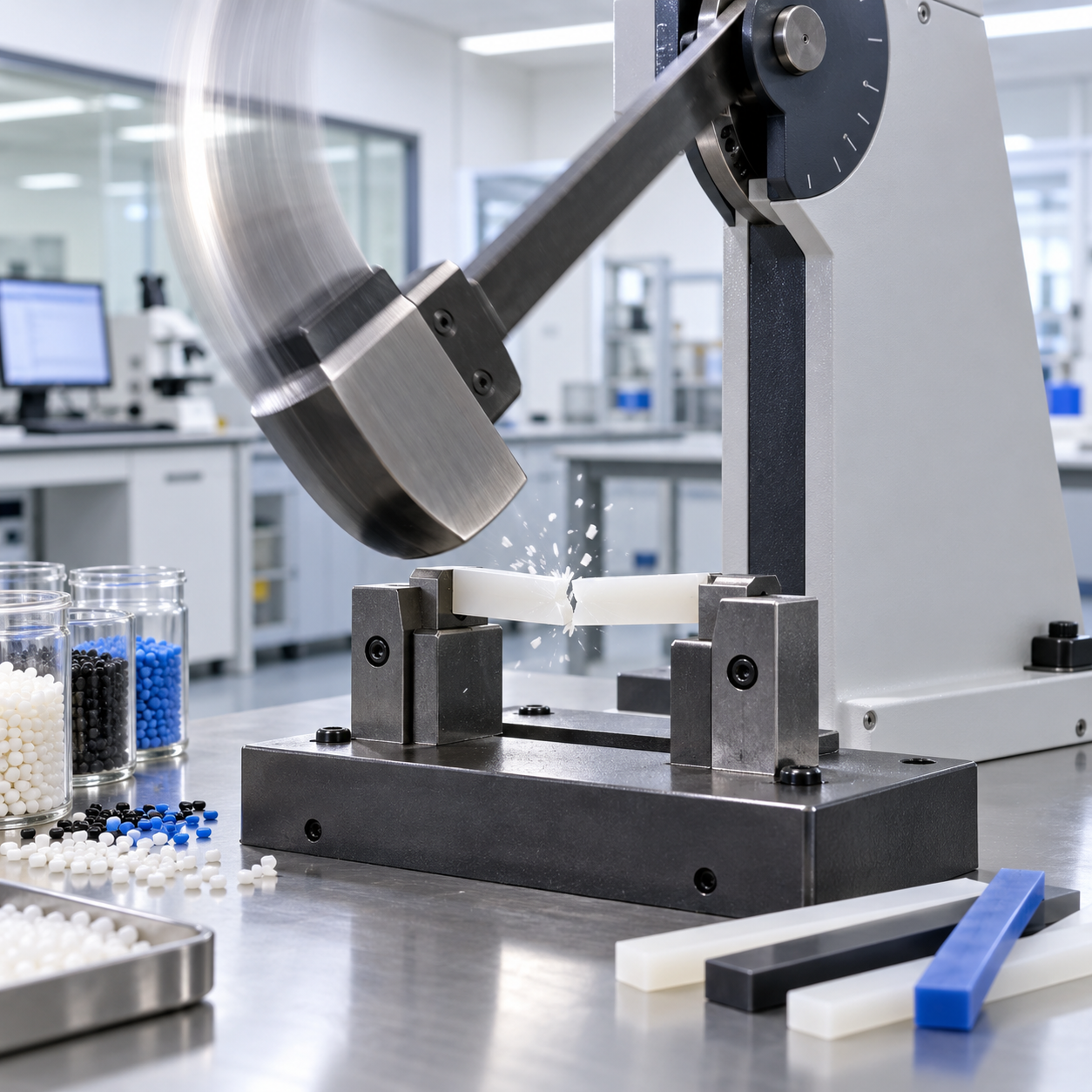
Impact testing measures how well a material withstands sudden loading. Two common methods used in plastic material testing are Izod and Charpy.
ISO 180:2023 specifies methods for determining Izod impact strength, while ISO 179-1:2026 covers Charpy impact testing.
Although both methods evaluate impact behavior, the specimen arrangement and test configuration are different.
Therefore: Izod is not equivalent to Charpy.
For example, a Charpy value of 20 kJ/m² should not be directly compared with an Izod value of 10 kJ/m² to conclude that one material provides twice the impact resistance.
When reviewing impact-test data, manufacturers should check:
-
whether the method is Izod or Charpy;
-
whether the specimen is notched or unnotched;
-
test temperature;
-
measurement unit.
These details are important in plastic quality testing, particularly when comparing materials from different suppliers.
A higher impact value is only meaningful when the test method and conditions are comparable.
4. Thermal testing of engineering plastics
Thermal testing evaluates how a plastic behaves as temperature increases. This is particularly important for components used near engines, electrical equipment, heating systems, or other heat sources.
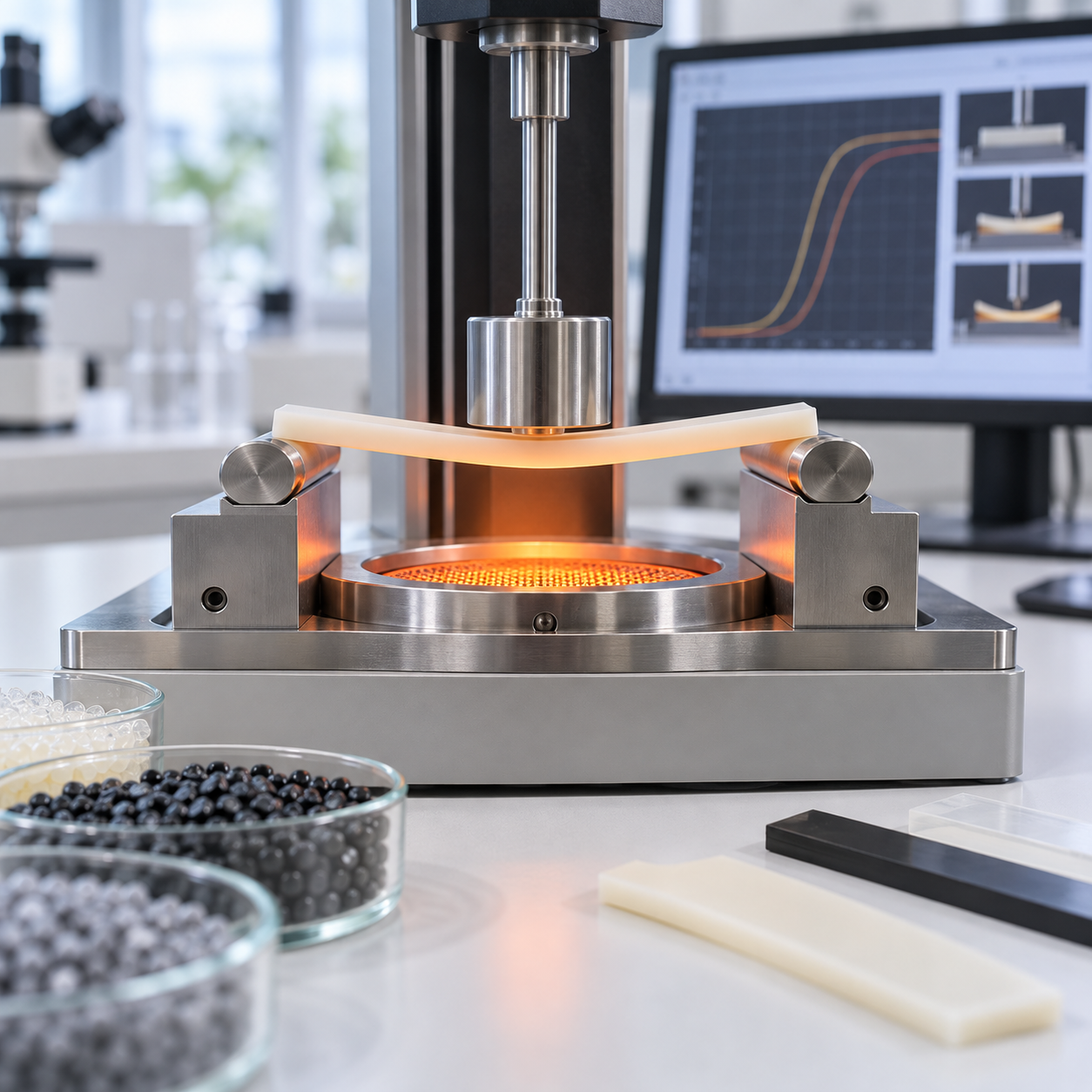
Two commonly used indicators are heat deflection temperature (HDT) and Vicat softening temperature.
HDT evaluates how a plastic deforms when exposed to both heat and a specified flexural stress. ISO 75-2:2013 specifies three stress levels for determining HDT: 1.80 MPa, 0.45 MPa, and 8.00 MPa. This means HDT values should only be compared when the same test condition has been used.
Vicat softening temperature evaluates when a thermoplastic begins to soften under specified conditions. According to ISO 306:2022, the test uses loads of 10 N or 50 N combined with heating rates of 50°C/h or 120°C/h, depending on the method.
The difference can be summarized as follows:
| Test |
Main purpose |
| HDT |
Evaluates deformation under both heat and load |
| Vicat |
Evaluates softening behavior as temperature increases |
HDT and Vicat therefore measure different engineering plastics properties.
For reliable plastic material testing, manufacturers should check not only the reported temperature but also the test method and operating conditions of the final component.
5. Abrasion testing
Abrasion testing measures a material's resistance to wear caused by friction or repeated contact. This property is particularly important for plastic gears, bushings, guide rails, and other moving parts.
ISO 9352:2012 describes a method for determining the abrasion resistance of plastics using abrasive wheels.
An important point in plastic quality testing is that high mechanical strength does not automatically mean strong wear resistance.
Actual wear performance can also be influenced by:
-
applied load;
-
friction;
-
movement speed;
-
temperature;
-
operating conditions.
For example, a plastic gear should not be selected only because it has high tensile or flexural strength. The material must also withstand repeated surface contact during operation.

6. Heat deformation testing
Heat deformation testing is used to evaluate whether a plastic can maintain its shape when exposed to heat and mechanical load. This is an important part of plastic quality testing for engineering plastics used in automotive, electrical and electronic, and machinery applications.
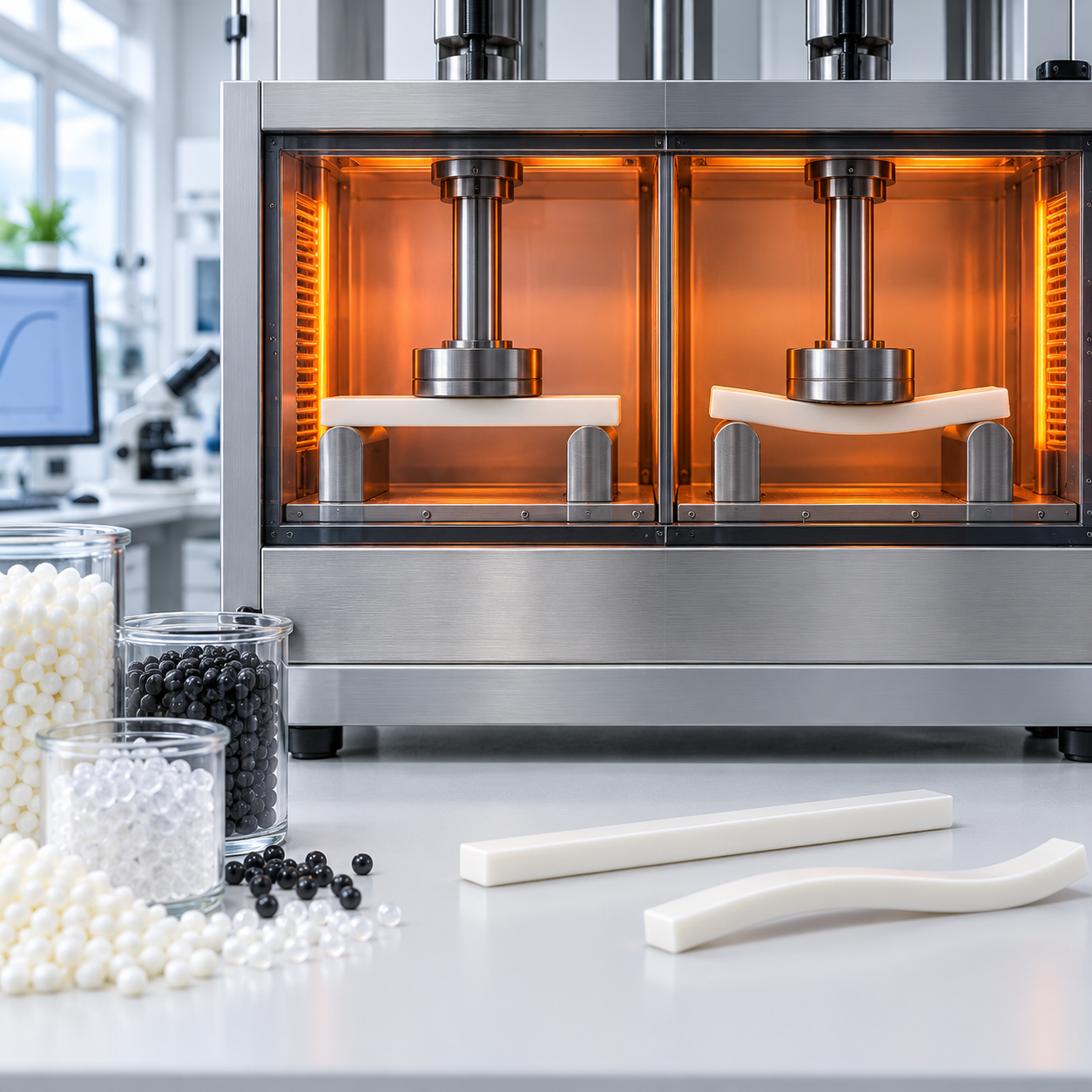
ISO 75-1:2020 provides the general method for determining heat deflection temperature. During the test, the specimen is subjected to flexural stress while the temperature is gradually increased until a specified level of deformation is reached.
One point is particularly important: HDT is not the same as the maximum continuous service temperature of a finished product.
For example, a material with an HDT of 150°C should not automatically be considered suitable for continuous operation at 150°C.
Actual performance may also depend on:
-
applied load;
-
duration of heat exposure;
-
part geometry and wall thickness;
-
operating environment;
-
filler and reinforcement system.
For this reason, HDT is most useful for comparing and screening materials tested under equivalent conditions.
For critical applications, laboratory plastic material testing should then be followed by validation on the actual component and under representative operating conditions.
This approach provides a more reliable assessment of engineering plastics properties than relying on a single value from a technical data sheet.
7. Flammability testing
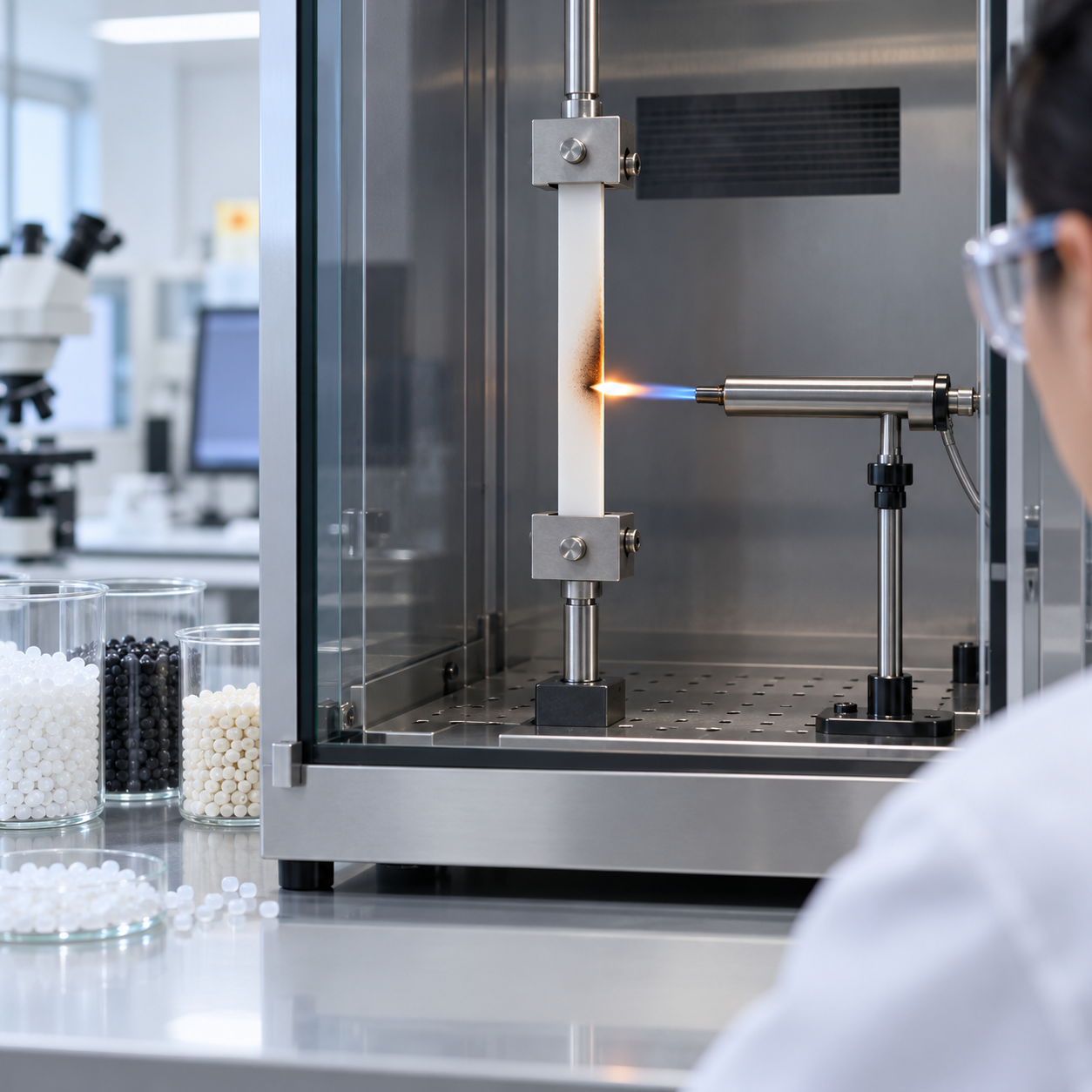
Flammability testing is especially important for engineering plastics used in electrical and electronic equipment, household appliances, automotive parts, and components located near heat or electrical sources.
One of the most widely used systems is UL 94. It classifies the burning behavior of plastic materials based on factors such as afterflame time, self-extinguishing behavior, and flaming drips.
For vertical testing, common ratings include:
Among these, V-0 requires shorter afterflame times and stricter control of flaming drips than V-1 and V-2.
However, a UL 94 rating does not represent the overall fire safety of a finished product. Results can also be affected by specimen thickness, part design, and actual service conditions.
Practical tip: when reviewing flammability data, always check both the UL 94 rating and the tested thickness. The same material may achieve different classifications at different thicknesses.
8. Aging testing
Aging testing evaluates how plastics change after prolonged exposure to heat, light, moisture, or other environmental conditions. It is an important part of plastic quality testing for products that must maintain performance over a long service life.
For light and weathering exposure, ISO 4892-2 covers xenon-arc lamp testing, while ISO 4892-3:2024 uses fluorescent UV radiation together with controlled heat and moisture.
After aging, the material may be checked again for:
-
color and surface changes;
-
tensile strength;
-
elongation;
-
impact resistance;
-
cracking or embrittlement.
A material with strong initial performance does not necessarily retain the same engineering plastics properties after long-term exposure.
According to ISO 4892-1:2024, accelerated aging results should also be interpreted carefully. Laboratory exposure time should not be directly converted into an exact number of years in real outdoor use unless a reliable correlation has been established.

9. How to interpret plastic quality testing results
Test values are only useful when they are interpreted in the right context. In plastic material testing, a material with the highest number in one category is not automatically the best option for every application.
9.1. Do not rely on one property alone
A plastic with high stiffness may work well for a structural support but may not be suitable for a part that must absorb impact.
Similarly, a material with good heat resistance may still have limited elongation or poor abrasion resistance.
For this reason, manufacturers should first identify which engineering plastics properties are critical for the final product, then compare materials based on those priorities.
9.2. Compare results under equivalent test conditions
Before comparing two materials, check:
-
test standard;
-
unit of measurement;
-
specimen size and geometry;
-
whether an impact specimen is notched or unnotched;
-
test temperature;
-
specimen thickness for flammability testing.
For example, Izod values should not be compared directly with Charpy values. HDT values measured at different stress levels should also not be treated as equivalent.
This is one of the most important principles in plastic quality testing, especially when comparing technical data from different suppliers.
9.3. Match test results with final-product requirements
A simple evaluation process can be summarized as:
Application → Required properties → Test results → Material selection
For example, an electrical housing may require impact resistance, thermal stability, and flame resistance at the same time. A plastic gear, on the other hand, may place more emphasis on abrasion resistance and dimensional stability.
Therefore, there is no single engineering plastic that is best for every application. The most suitable material is the one whose tested properties match the requirements of the final product.
10. Frequently asked questions about plastic quality testing
10.1. What are the main plastic quality testing methods for engineering plastics?
Common methods include mechanical testing, impact testing, thermal testing, abrasion testing, heat deformation testing, flammability testing, and aging testing. The relevant tests depend on the intended application.
10.2. What is the difference between tensile strength and flexural strength?
Tensile strength measures how a material performs under pulling force, while flexural strength measures its resistance to bending. They represent different loading conditions and should not be treated as interchangeable.
10.3. Are Izod and Charpy the same plastic testing method?
No. Both measure impact behavior, but the specimen arrangement and test configuration are different. Their results should not be compared directly.
10.4. What is the difference between HDT and Vicat?
HDT evaluates deformation when a material is exposed to both heat and load. Vicat evaluates the softening behavior of a thermoplastic as temperature increases under specified test conditions.
10.5. Why is flammability testing important?
Many engineering plastics are used near electrical or heat sources. Flammability testing helps evaluate how a material behaves when exposed to flame and supports material selection for applications with fire-performance requirements.
10.6. Why is aging testing necessary?
Aging testing helps determine how a material's appearance and performance change after prolonged exposure to heat, light, moisture, or other environmental factors.
10.7. Is a plastic with higher tensile strength always better?
No. Tensile strength is only one of many engineering plastics properties. Impact resistance, elongation, thermal behavior, abrasion resistance, and other characteristics may be more important depending on the application.
10.8. How can manufacturers determine whether a plastic is suitable?
The process should start with the requirements of the final product, followed by comparison of results obtained under equivalent plastic testing methods and conditions. For critical applications, laboratory data should also be confirmed through testing on the actual part and under realistic production conditions.
11. Conclusion
Plastic quality testing should not rely on a single number. Mechanical performance, impact resistance, thermal behavior, abrasion resistance, heat deformation, flame resistance, and aging performance all provide different information about material quality.
When comparing materials, the most important principle is to use equivalent test methods and conditions, then match the results with the actual requirements of the final product.
A higher value is not automatically better if that property is not critical to the application. Laboratory data should therefore be used to screen and compare materials, followed by validation under representative production and service conditions.
This provides a more reliable basis for plastic material testing and material selection.
12. About EuroPlas
EuroPlas is a manufacturer and supplier of plastic material solutions, with engineering plastics compounds as one of its key product groups.
EuroPlas develops engineering plastics based on polymer systems such as ABS, PC, PBT, POM, PA, HIPS, and PP. Depending on the application, materials can be modified with mineral fillers, glass fiber, or functional additive systems to adjust:
-
mechanical performance;
-
heat resistance;
-
dimensional stability;
-
flame resistance;
-
antistatic properties;
-
color and processability.
These materials can be used in automotive, electrical and electronics, household appliances, machinery components, and other industrial applications.
When selecting a material, manufacturers should begin with the required engineering plastics properties, processing conditions, and performance targets, then confirm them through appropriate plastic quality testing.
Contact EuroPlas for consultation on engineering plastics compounds tailored to your application and production requirements.
13. About the Author
EuroPlas Technical Content Team
This article was prepared by the EuroPlas specialist team based on knowledge and experience in plastic materials, masterbatch, additives, and engineering plastic compounds. EuroPlas aims to provide clear and practical technical information to help manufacturers better understand material properties, potential applications, and key considerations when selecting plastic materials for production.
The information provided in this article is for reference purposes. Formulation, loading levels, and material performance should be evaluated according to the polymer type, processing technology, and actual end-use conditions.