Black masterbatch is widely used to produce black polyethylene (PE) film for applications ranging from packaging and garbage bags to industrial films and agricultural mulch films. However, selecting the right black masterbatch for PE film involves much more than choosing the grade with the highest carbon black content.
Blackness, carbon black dispersion, carrier resin compatibility, dosage, PE film opacity, processing conditions, and UV protection can all directly affect the appearance, processability, and long-term performance of the finished film.
In practice, a suitable black masterbatch should disperse carbon black evenly throughout the PE matrix, provide the required blackness and opacity, and avoid excessive surface defects or processing problems during blown film extrusion. For outdoor applications, UV resistance becomes another important consideration because the film may be exposed to sunlight for extended periods.
For this reason, black masterbatch should not be evaluated based on a single technical parameter. Manufacturers should consider the combination of color strength, carbon black content, dispersion quality, carrier resin, dosage, UV performance, and final application requirements before selecting a grade.
1. What role does black masterbatch play in PE film production?
Black masterbatch is a concentrated coloring material typically made from carbon black, a polymer carrier, and selected additives that support dispersion and processing. When blended with PE during extrusion, it allows carbon black to be introduced into the polymer more consistently and conveniently than direct handling of carbon black powder. Black masterbatch's applications including blown film, pipes, blow molding, injection molding, and other plastic manufacturing processes.
In PE film production, black masterbatch generally performs three important functions.
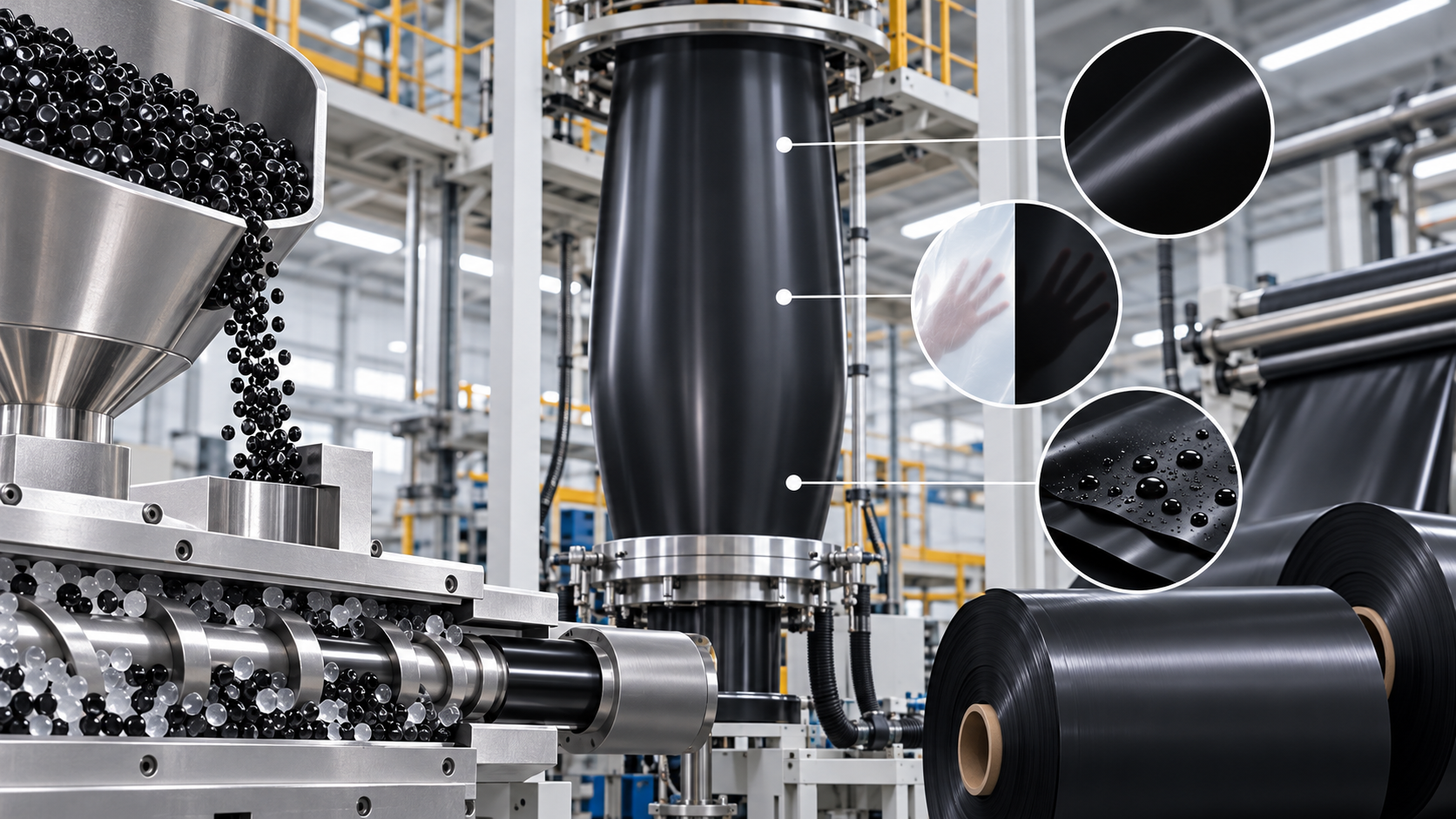
The first is coloration and opacity. Carbon black absorbs a large proportion of visible light, helping create a deep black appearance while reducing light transmission through the film. However, final blackness is not determined by carbon black loading alone. Particle characteristics, dispersion quality, film thickness, and dosage all influence the result.
The second is maintaining color and surface uniformity. In thin films, poorly dispersed carbon black agglomerates can become much more noticeable than in thick molded parts. They may appear as specks, streaks, uneven color, or surface imperfections.
The third is supporting UV protection in suitable applications. Cabot notes that carbon black can absorb ultraviolet radiation in polymers, helping reduce UV-related degradation that can otherwise contribute to loss of mechanical properties, color changes, or surface deterioration.
For this reason, especially in agricultural films and outdoor industrial films, black masterbatch should not be viewed simply as a colorant.
2. Three key criteria when choosing black masterbatch for PE film
2.1. Blackness, color strength, and carbon black content
One common mistake when comparing black masterbatch grades is assuming that higher carbon black content automatically means better performance.
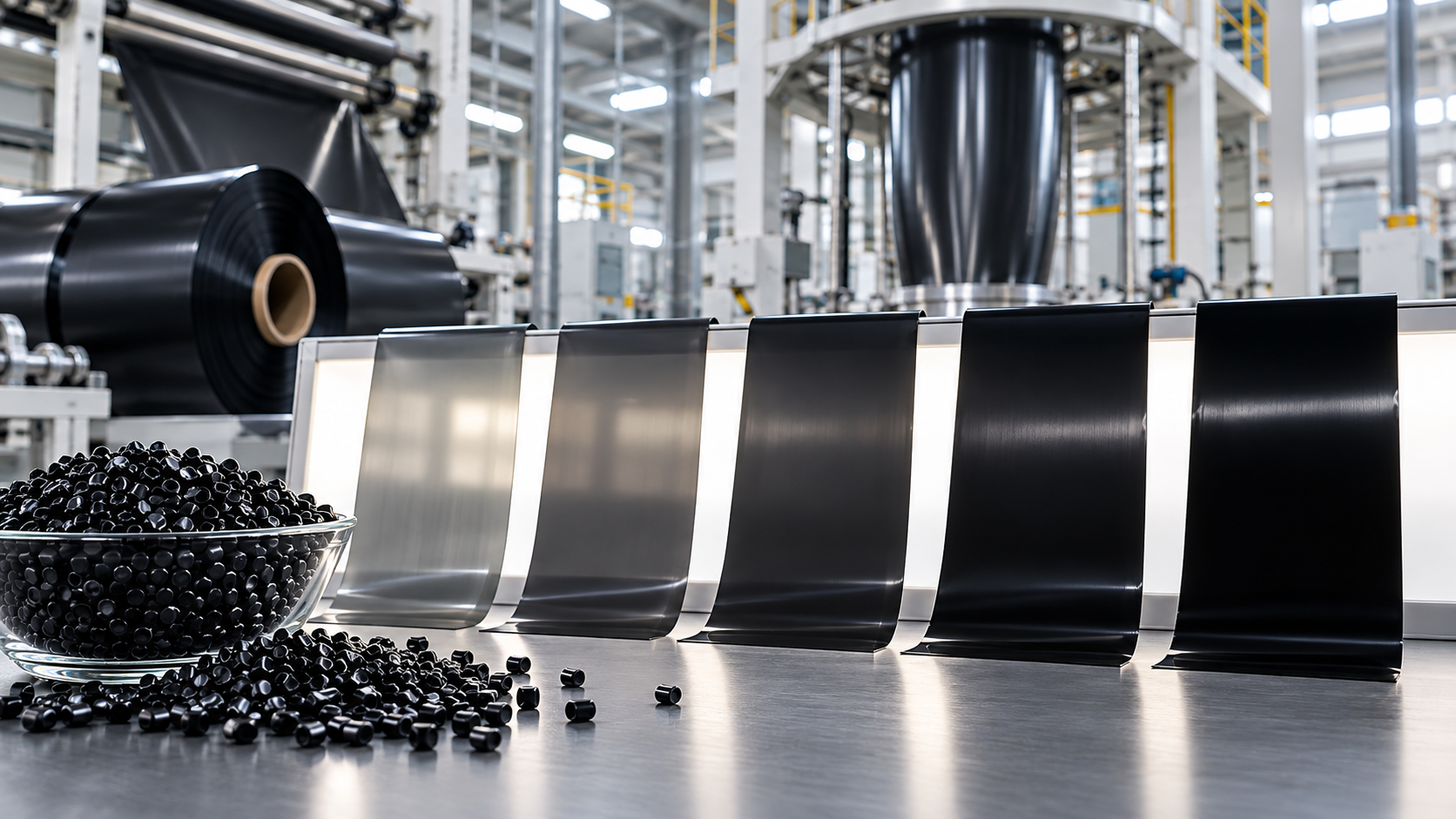
In reality, carbon black content only indicates the proportion of carbon black present in the masterbatch. It does not fully describe how efficiently the masterbatch will deliver blackness, opacity, or color strength in the final PE film.
Two black masterbatches with similar carbon black content can still produce very different results if the carbon black type, particle characteristics, structure, or dispersion quality differs.
Orion Engineered Carbons explains that smaller carbon black particle sizes are generally associated with deeper blackness, while larger particles can produce different shades and performance characteristics depending on the application.
For PE film manufacturers, it is therefore useful to distinguish between three concepts:
-
Carbon black content: the percentage of carbon black in the masterbatch.
-
Color strength or blackness: how effectively the masterbatch produces a deep black appearance at a given dosage.
-
Opacity: how effectively the finished PE film blocks visible light.
This distinction becomes particularly important in thin-film applications.
For example, two masterbatches may both contain relatively high levels of carbon black. If the first grade offers better dispersion and uses a carbon black type suited to high color strength, it may achieve the target blackness at a lower addition rate. The second grade may contain a similar or even higher carbon black concentration but still require a greater dosage if dispersion is poor.
Therefore, instead of asking only:
“What percentage of carbon black does this masterbatch contain?”
A more useful question is:
“At the actual dosage used in my PE film formulation, what blackness, opacity, and surface quality can this masterbatch achieve?”
The most reliable answer usually comes from testing the material under actual production conditions.
2.2. Carbon black dispersion
For PE film, carbon black dispersion can be just as important as carbon black content.
Carbon black consists of extremely fine particles that tend to form aggregates and larger agglomerates. During masterbatch production, these structures need to be properly broken down and distributed through the carrier resin.
If dispersion is inadequate, larger carbon black agglomerates may remain in the material. Once the masterbatch is used in blown film extrusion, these agglomerates can contribute to visible defects or localized stress points.
Because PE film is relatively thin, dispersion-related defects may become especially noticeable.
Possible signs of poor carbon black dispersion include:
-
visible black specks or particles;
-
non-uniform color;
-
streaks across the film;
-
irregular or rough surface appearance;
-
inconsistent film quality between production batches.
Cabot identifies dispersion, opacity, and surface appearance as relevant performance factors for specialty carbon blacks used in film and sheet applications. Cabot’s film and sheet application information highlights the importance of dispersion when carbon black is incorporated into plastic films.
At the material-testing level, ISO 18553:2025 provides a method for assessing pigment or carbon black particle size, agglomerate size, and dispersion in polyolefin materials used for pipes, fittings, and compounds.
Although this standard is not specifically designed for PE films, it illustrates an important point: carbon black dispersion can be evaluated systematically rather than judged only by visual color appearance.
For PE film manufacturers, however, final testing on actual film remains essential because film thickness, extrusion speed, die design, cooling conditions, and the overall formulation can all influence how the masterbatch performs in production.

2.3. UV protection and outdoor durability
For indoor packaging or standard garbage bags, color and processability may be the main priorities.
For agricultural mulch film, outdoor protective film, construction film, or other products exposed to sunlight, however, UV resistance should be considered during masterbatch selection.
UV radiation can promote photo-oxidative degradation of polymers. Over time, this may reduce flexibility, mechanical strength, or surface quality.
Carbon black is widely used in polyolefins because it can absorb UV radiation and convert part of the absorbed energy into heat, reducing the amount of damaging radiation reaching the polymer structure.
However, UV performance does not depend simply on whether carbon black is present.
According to Cabot, carbon black particle size, structure, loading, and dispersion quality can influence UV protection performance.
This has an important practical implication:
A formulation may contain enough carbon black by weight, but poor dispersion can still reduce the effectiveness of UV protection.
Orion also notes that carbon black levels of approximately 2.0–2.5% by weight in the polymer are often used as a reference range for UV stabilization in polyolefins. Orion’s technical information on specialty carbon black for polymers discusses this application range.
This should not, however, be treated as a universal specification for every PE film.
Required service life, film thickness, geographic UV exposure, carbon black type, additive package, polymer grade, and final-product standards all need to be considered before determining the appropriate carbon black concentration.

3. Black masterbatch dosage is not the same as final carbon black content
This is an important distinction in black masterbatch formulation.
The percentage of black masterbatch added to a PE formulation is not the same as the final carbon black concentration in the finished film.
For example, if a black masterbatch contains 40% carbon black and is used at a dosage of 5%:
Final theoretical carbon black content = 40% × 5% = 2%.
This simple calculation explains why manufacturers need to know both the carbon black concentration of the masterbatch and its recommended addition rate.
Cabot, for example, offers a PE-based black masterbatch containing 40% carbon black with a typical addition rate of 6.25%. This would theoretically result in approximately 2.5% carbon black in the final polymer formulation. The product is designed for applications requiring enhanced UV protection. Cabot PLASBLAK PE2668 technical data.
This example does not mean every PE film should use 6.25% black masterbatch.
It simply demonstrates the relationship between:
carbon black concentration in the masterbatch → masterbatch dosage → final carbon black concentration in the PE film.
All three should be considered together with the actual requirements of the finished product.
4. How does carrier resin affect black masterbatch performance in PE film?
Besides carbon black, the carrier resin is another important component of black masterbatch.
For PE film, a carrier resin that is compatible with polyethylene generally supports more uniform blending and easier incorporation during extrusion.
Common PE materials used in blown film include LDPE, LLDPE, and HDPE. Each resin has different rheological behavior, mechanical characteristics, and processing requirements. As a result, not all PE-based black masterbatches will behave identically in every film formulation.
Manufacturers should review several technical parameters before selecting a grade:
| Parameter |
Why it matters |
| Carrier resin |
Influences compatibility with the base PE |
| Melt flow index |
Helps indicate flow behavior and processing compatibility |
| Carbon black content |
Affects dosage and final carbon black concentration |
| Carbon black type |
Influences blackness, dispersion, and UV performance |
| Additive package |
May support dispersion, processing, or stabilization |
| Recommended dosage |
Provides a starting point for production trials |
A technical data sheet is useful for preliminary screening, but it should not replace production testing.
A black masterbatch may look suitable on paper yet behave differently when used in very thin films, at high extrusion speeds, or in formulations containing significant amounts of recycled PE.
5. Choosing black masterbatch for different PE film applications
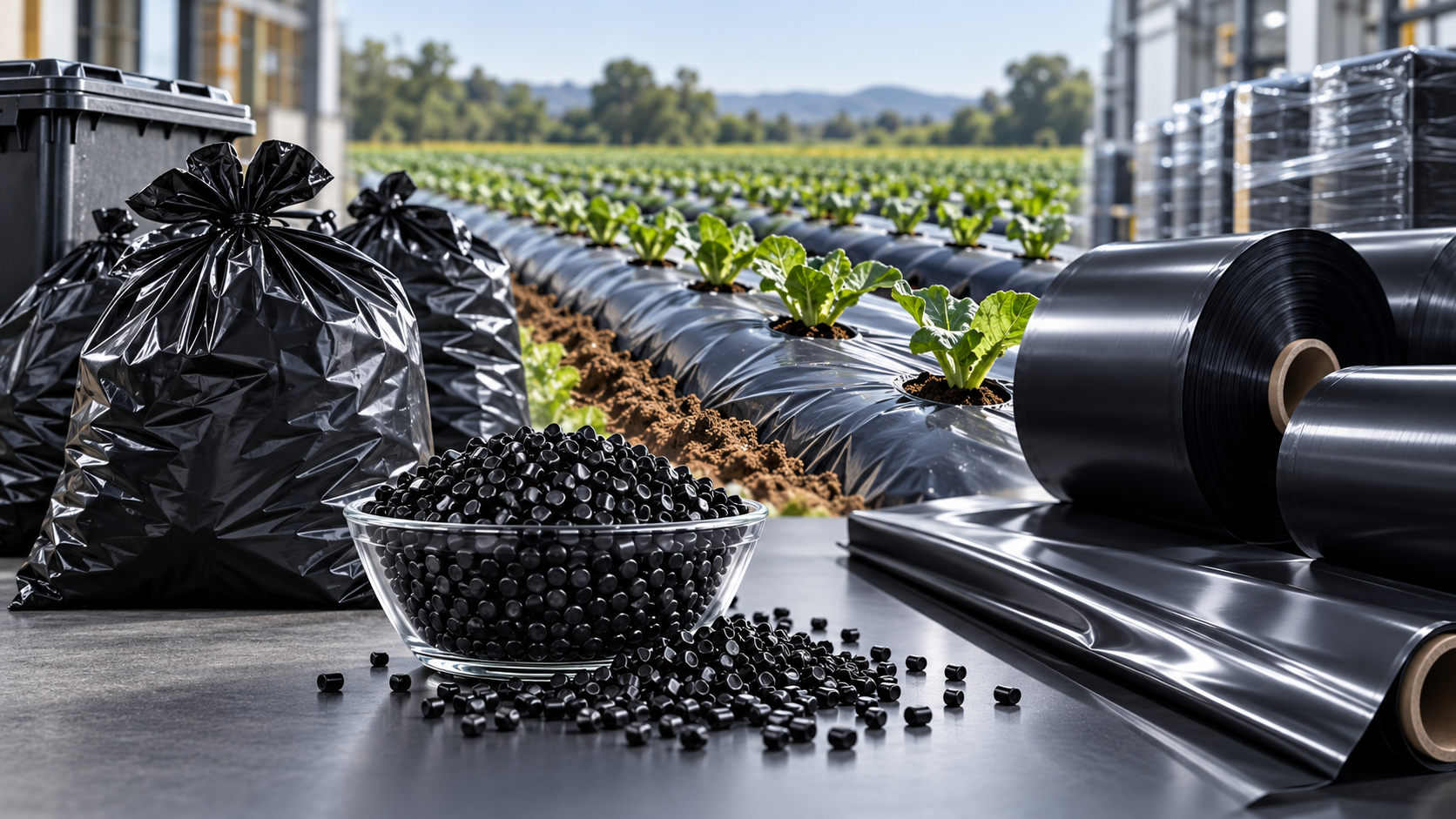
5.1. Garbage bags and black packaging film
For garbage bags, industrial sacks, and general black packaging films, the main requirements often include opacity, color consistency, and material cost.
In these applications, achieving the deepest possible black shade is not always necessary.
A black masterbatch that reaches the required opacity and appearance at a relatively low dosage can offer better cost efficiency than a grade with a high carbon black loading but poor color strength.
This becomes even more important when recycled PE is used because the color of recycled feedstock may vary significantly from batch to batch.
Manufacturers should therefore evaluate:
-
color uniformity;
-
ability to cover the base resin color;
-
visible specks or undispersed particles;
-
film surface quality;
-
processing stability during continuous production.
5.2. Agricultural mulch film
Black masterbatch for agricultural film requires a different approach.
Black mulch film typically needs to block light effectively while also maintaining mechanical performance during prolonged exposure to sunlight.
According to Cabot’s information on black masterbatches for agricultural film, carbon black is commonly used in agricultural films because of its ability to absorb UV radiation, while weathering performance is influenced by both carbon black characteristics and masterbatch formulation.
For this reason, agricultural film should be evaluated based on the combination of:
light-blocking ability + dispersion quality + UV resistance + required service life.
Checking only the film color immediately after extrusion is not enough.
5.3. Outdoor industrial PE film
Construction film, protective covers, outdoor packaging film, and other industrial PE films may be expected to retain their performance for months or even longer.
In these cases, manufacturers should determine:
-
expected outdoor service life;
-
local climate and UV exposure;
-
film thickness;
-
final carbon black concentration;
-
whether additional UV stabilizers are required.
Black masterbatch can contribute significantly to weather resistance, but carbon black should not automatically be assumed to replace all UV stabilizers in every formulation.
6. Is additional UV masterbatch needed when black masterbatch is already used?
There is no universal answer.
Carbon black is an effective UV absorber and can provide substantial protection in many polyolefin applications. However, actual UV resistance depends on carbon black type, loading, dispersion, film thickness, and required service life.
For demanding outdoor applications, manufacturers may still need to consider additional UV stabilizer masterbatch or other stabilization systems.
The key is to avoid the assumption:
“The film is black, so it must already have sufficient UV protection.”
A visually black film does not automatically indicate that the polymer has adequate long-term UV stability.
If outdoor durability is a critical technical requirement, accelerated weathering tests or other relevant test methods should be considered according to the performance standard of the finished product.
7. Which technical parameters should be checked before selecting black masterbatch?
A useful technical evaluation does not necessarily require dozens of specifications.
For black masterbatch for PE film, several parameters are particularly relevant.
Carbon black content: helps calculate the theoretical final carbon black concentration in the film.
Carrier resin: helps assess compatibility with LDPE, LLDPE, HDPE, or other PE grades.
Melt flow index: provides an indication of processing behavior and flow characteristics.
Carbon black dispersion: especially important for thin films and applications requiring a smooth, uniform surface.
Color strength and opacity: should ideally be evaluated at comparable film thicknesses and addition rates.
UV requirements: should be reviewed separately for products designed for outdoor use.
Regulatory compliance: for food-contact or otherwise regulated applications, relevant compliance documents should be checked before material approval.
For determining carbon black content in polyethylene, ASTM D1603-20 provides a test method based on pyrolysis under nitrogen. ASTM notes that the method can be used for quality control, technical service, and research purposes.
8. A practical process for selecting black masterbatch for PE film
Choosing black masterbatch does not need to be overly complicated, but it should follow a consistent evaluation process.
- The first step is to define the performance requirements of the finished film, including blackness, opacity, thickness, intended service life, and outdoor exposure.
- Next, manufacturers can shortlist several black masterbatch grades with suitable carrier resins and technical properties and test them under the same formulation conditions.
- During production trials, variables such as PE grade, processing temperature, film thickness, and extrusion speed should be kept as consistent as possible. This allows differences in film performance to be more clearly linked to the masterbatch itself.
- The final comparison should also go beyond the purchase price per kilogram.
A more useful metric is the total cost required to produce acceptable finished film.
A black masterbatch with a higher price per kilogram may still be more cost-effective if it delivers the required blackness at a lower dosage, produces fewer defects, and supports stable processing.
This is why practical production trials usually provide more value than comparing products only by carbon black content or unit price.
9. EuroPlas Black Masterbatch
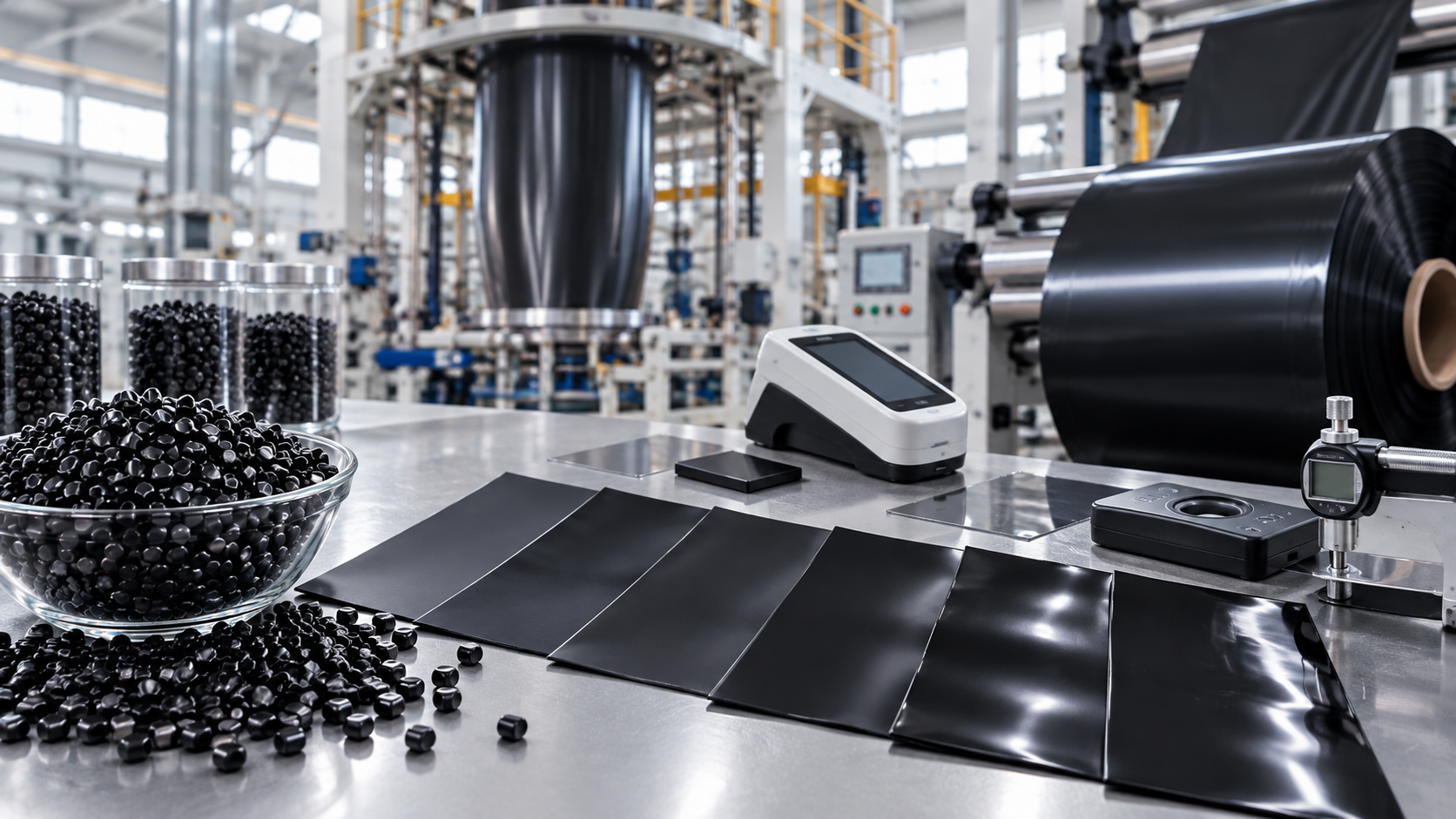
EuroPlas supplies Black Masterbatch grades developed for a wide range of plastic applications, including PE blown film, packaging, plastic bags, pipes, blow molding, and injection molding.
Contact EuroPlas for technical support in selecting the most suitable Black Masterbatch for your PE film formulation, processing conditions, and finished-product requirements.
10. Frequently asked questions about black masterbatch for PE film
10.1. Which black masterbatch is suitable for PE film?
A suitable black masterbatch for PE film should use a carrier resin compatible with polyethylene, provide good carbon black dispersion, and deliver the required color strength and opacity at a practical dosage.
For outdoor films, UV performance and expected service life should also be evaluated.
10.2. Is a higher carbon black content always better?
No. A higher carbon black percentage simply means the masterbatch contains more carbon black. Final performance also depends on carbon black type, particle characteristics, dispersion quality, carrier resin, and dosage.
Therefore, manufacturers should evaluate blackness and opacity in the finished PE film rather than comparing products only by carbon black percentage.
10.3. What is the recommended black masterbatch dosage for PE film?
There is no single dosage suitable for every PE film application.
The required addition rate depends on carbon black concentration in the masterbatch, target blackness, film thickness, PE grade, opacity requirements, and UV performance.
Manufacturers should begin with the supplier’s recommended dosage and then optimize the formulation through production trials.
10.4. Why do black PE films sometimes contain visible specks or uneven color?
One possible cause is poor carbon black dispersion or incomplete masterbatch distribution.
However, visible defects may also result from contamination, degraded polymer inside the extruder, unsuitable processing conditions, or poor mixing.
Both the raw material and the production process should therefore be checked before identifying the root cause.
10.5. Can black masterbatch improve UV resistance in PE film?
Yes.
Carbon black can absorb UV radiation and is widely used to improve the weather resistance of polyolefins.
However, the level of protection depends on carbon black type, concentration, dispersion quality, film thickness, and final application requirements.
10.6. Is UV masterbatch still needed when black masterbatch is used?
It depends on the application.
In some PE films, carbon black may provide sufficient UV protection. In applications that require longer outdoor service life or compliance with specific performance standards, additional UV stabilizers may still be necessary.
The decision should be based on technical requirements and appropriate testing rather than film color alone.
11. Conclusion
Choosing the right black masterbatch for PE film requires a broader evaluation than simply comparing carbon black content. Three of the most important factors are blackness and opacity, carbon black dispersion, and UV performance. Carrier resin compatibility, melt flow behavior, dosage, film thickness, and final-use conditions can also significantly influence the finished product.
This is especially important for thin PE films and outdoor applications, where a high-quality black masterbatch must do more than create a black appearance. It should disperse consistently throughout the polymer, support stable processing, and contribute to the required performance throughout the intended service life.
The most effective selection process is therefore to define the performance requirements of the finished film, review the technical data of suitable masterbatch grades, and validate them through actual production trials. This approach allows manufacturers to optimize not only film appearance, but also processing stability, durability, and overall material cost.
12. About the Author
EuroPlas Technical Content Team
This article was prepared by the EuroPlas specialist team based on knowledge and experience in plastic materials, masterbatch, additives, and engineering plastic compounds. EuroPlas aims to provide clear and practical technical information to help manufacturers better understand material properties, potential applications, and key considerations when selecting plastic materials for production.
The information provided in this article is for reference purposes. Formulation, loading levels, and material performance should be evaluated according to the polymer type, processing technology, and actual end-use conditions.