In plastic manufacturing, two materials recommended for the same product can produce completely different results. One material may cause high injection pressure, incomplete filling, or longer production cycles. Another may lead to flashing, sagging, or insufficient mechanical performance. These differences are often related to the material’s flow characteristics, which are commonly expressed through Melt Flow Index (MFI), or Melt Flow Rate (MFR). However, a higher flow rate is not always better. The appropriate value must be determined based on the polymer type, processing technology, product design, performance requirements, and machine capability.
This article explains the main factors that influence polymer flow behavior and outlines how to determine the most suitable melt flow rate in actual production. From material selection and processing technology to product design and trial data, each factor plays an important role in choosing the right plastic material.
To make an accurate selection, manufacturers should begin by reviewing the material’s technical data sheet. They should then conduct production trials and monitor parameters such as pressure, screw torque, cycle time, product weight, and defect rate. This approach is considerably more reliable than selecting a material based on a single MFI, MFR, or melt flow rate value.
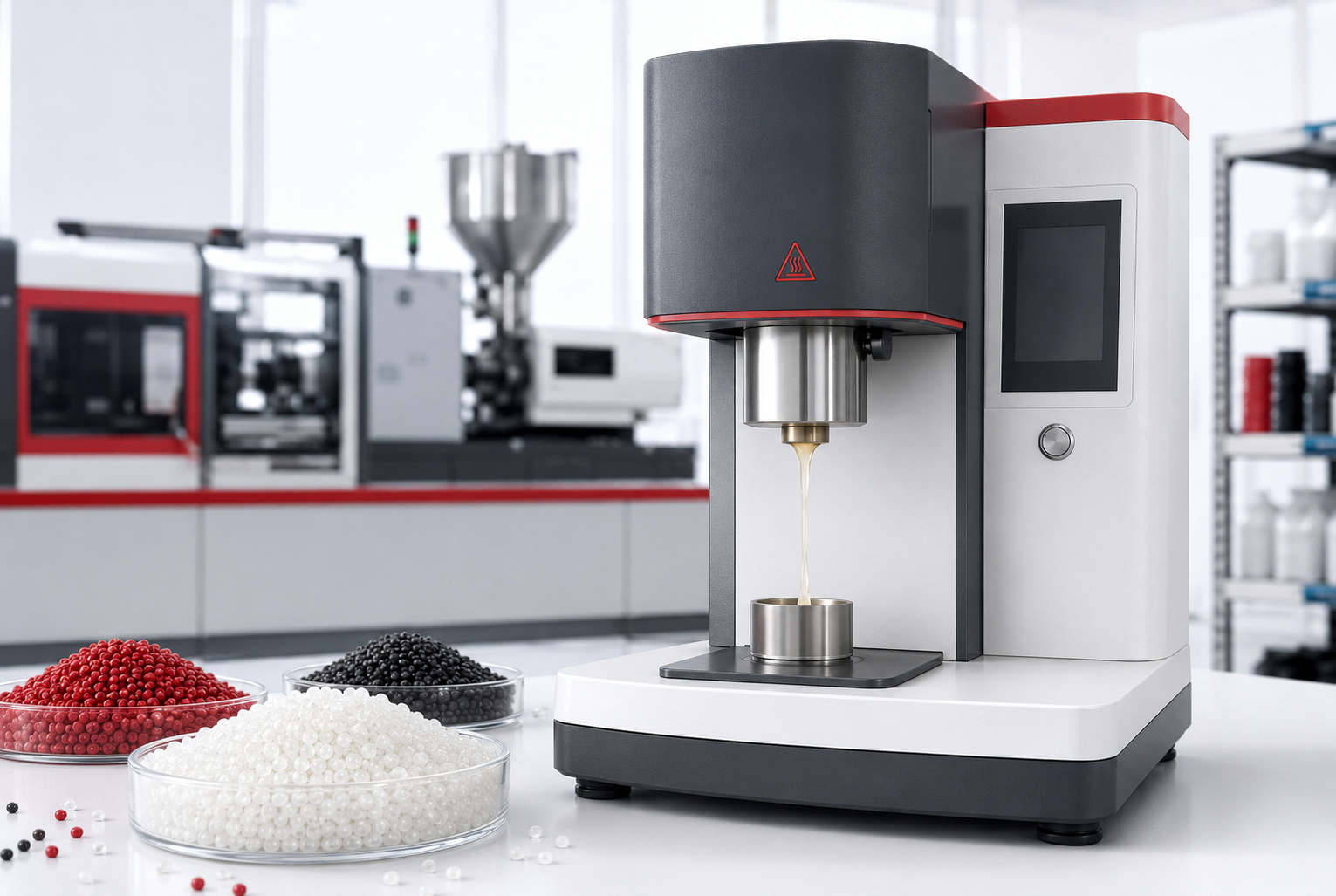
1. Which factors determine the appropriate melt flow rate?
1.1. Polymer type
Each polymer has a different molecular structure, processing temperature, and flow behavior. Therefore, the same MFI, MFR, or melt flow rate range cannot be applied to PP, PE, ABS, PA, PC, PET, POM, and other engineering plastics.
Even when two materials have an MFI of 10 g/10 min, their processing behavior may differ significantly if they belong to different polymer groups. This is because melt flow values may be measured under different temperature and load conditions. Each polymer also responds differently to heat, pressure, and shear during processing.
Before comparing flow properties, manufacturers should verify at least four factors:
- Polymer type
- Test standard
- Test temperature
- Applied load
Only values measured under the same conditions should be compared directly. The same principle applies to melt flow rate, which should always be evaluated together with its specified test conditions.
1.2. Processing method
Each plastic processing technology requires different flow characteristics.
- In injection molding, the molten plastic must pass through the nozzle, runner, and gate before filling the mold cavity. Thinner products, longer flow paths, and molds with more cavities generally require materials with better flowability.
- In extrusion, the objective is not to make the polymer flow as quickly as possible. Instead, manufacturers need to maintain a stable output while allowing the product to retain its shape after leaving the die. If the melt flow rate is too high, pipes, sheets, or profiles may deform or sag before they are fully cooled.
- Blown film production requires a balance between flowability and melt strength. When a material flows too easily, the film bubble may fluctuate, lose diameter stability, or develop uneven thickness.
- In blow molding, the parison must retain its shape until the mold closes. An excessively high flow rate may cause the parison to stretch or sag, resulting in uneven wall-thickness distribution.
Therefore, the correct question is not whether a higher MFI or melt flow rate is always better. Manufacturers should instead determine which flow characteristics are suitable for the specific polymer, process, and product.
1.3. Wall thickness and flow length
Wall thickness directly affects the material’s ability to fill a mold. When molten plastic contacts the mold surface, the outer layer begins to cool and solidify. The thinner the product wall, the more quickly the remaining flow channel becomes restricted.
However, wall thickness should not be evaluated independently. Two products may both have a wall thickness of 0.8 mm but require different flow properties because of their different flow lengths. For example, a small cap with a flow length of 30 mm is generally easier to fill than a large container with the same wall thickness but a flow length of 150 mm.
In addition to wall thickness and flow length, manufacturers should consider:
- Gate position and size
- Number of flow-direction changes
- Ribs, threads, and other small features
- Sudden changes in cross-section
- Number of mold cavities
In practice, a short shot in an area far from the gate is not necessarily caused by a low melt flow value. Other possible causes include an undersized gate, an unbalanced runner system, low mold temperature, or inadequate venting. Switching to a material with a higher MFI or melt flow rate may improve cavity filling, but it will not correct the root cause if the mold design is unsuitable.
1.4. Mechanical performance requirements
Flow rate represents only one aspect of processability. It does not provide a complete indication of material quality.
A material that flows easily may not meet the required stiffness, tensile strength, load-bearing capacity, impact resistance, or heat resistance. For this reason, melt flow rate should always be considered together with other technical properties, including:
- Tensile strength
- Flexural modulus
- Impact strength
- Heat deflection temperature
- Shrinkage
- Dimensional stability
For example, a high-flow material may fill a mold quickly but may not provide sufficient toughness for a load-bearing plastic crate. Conversely, a material with strong impact resistance may require excessive processing pressure, making it unsuitable for a thin-wall product.
The correct material should provide a balance between processability and end-use performance. It can only be considered suitable when it runs consistently on the machine and meets the mechanical requirements of the finished product.
1.5. Machine and mold capability
The appropriate melt flow rate also depends on the operating limits of the machine and mold.
A machine with limited injection pressure, injection speed, or plasticizing capacity will have a narrower range of suitable materials. Important parameters include maximum pressure, screw load, clamping force, shot size, mold temperature, feeding stability, gate size, and venting efficiency.
In injection molding, manufacturers should monitor the pressure at the transfer point between the filling and holding stages. If this pressure regularly approaches the machine limit, the entire process should be evaluated before increasing the temperature or changing the material.
When pressure, filling time, and cushion volume fluctuate simultaneously, the problem may originate from the non-return valve, feeding system, or inconsistent material composition. In such cases, changing the MFI or melt flow rate may not solve the issue.
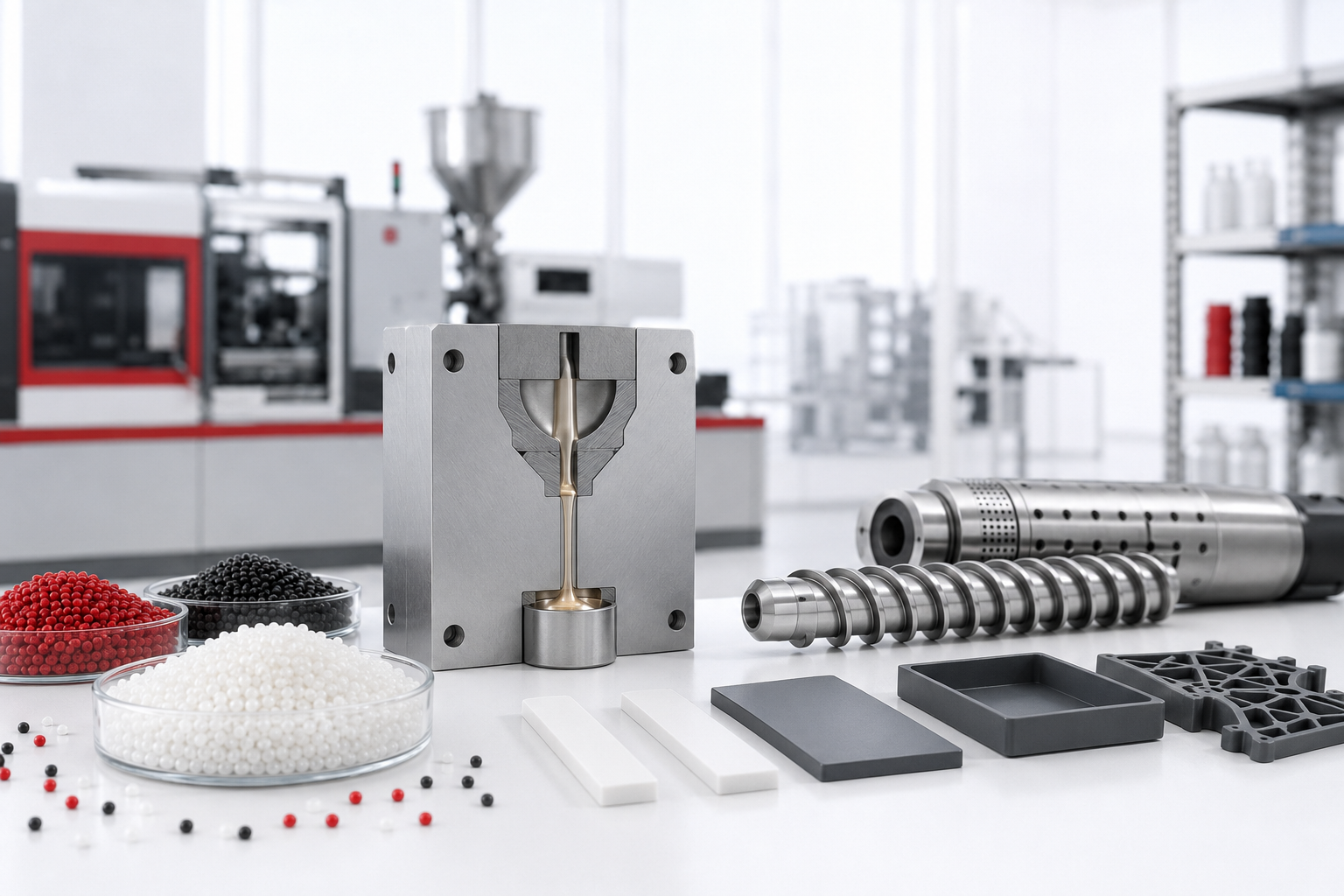
The appropriate melt flow rate also depends on the operating limits of the machine and mold.
1.6. Masterbatch, fillers, and recycled plastics
In actual production, the material entering the machine is often a mixture of base resin, filler masterbatch, color masterbatch, additives, and recycled plastic. When the formulation changes, the flow characteristics of the final blend may also change. The extent of this change depends on factors such as:
- Masterbatch carrier resin
- Filler content
- Particle size
- Surface treatment
- Pigment type
- Dispersing agents
- Dosage rate
Therefore, the MFI or melt flow rate of the virgin resin cannot fully represent the behavior of the final formulation. For plastic compounds, manufacturers should use the flow value of the finished compound rather than relying on the value of the base resin. Melt flow rate can be particularly useful when assessing compounds because it expresses the volume of material passing through the test die within a specified period.
Recycled plastics must also be controlled by source and production batch. Their previous thermal history, contamination level, and degree of degradation can cause considerable variations in flow behavior.
If the source of recycled plastic is changed or the regrind ratio is increased without conducting a new trial, pressure, product weight, and mechanical properties may change even when the machine settings remain unchanged.
2. How to determine the right melt flow rate step by step?
2.1. Identify the polymer and processing technology
The first step is to identify the exact polymer type and manufacturing process. Manufacturers need to distinguish between virgin resin, plastic compounds, filled materials, and recycled plastics.
They should not select a target MFI or melt flow rate first and then search for a matching material. A more reliable process begins with defining the product requirements, selecting the appropriate polymer family, and then comparing flow values among materials within the same group.
2.2. Analyze the product design
- For injection molding, manufacturers should identify the minimum wall thickness, maximum flow length, number of mold cavities, gate position, and areas that may be difficult to fill.
-
For extrusion, they should evaluate die dimensions, wall-thickness consistency, and the product’s ability to retain its shape after leaving the die.
-
In blown film and blow molding, additional considerations include melt strength, film bubble stability, and parison sagging.
-
The more thoroughly the design is analyzed, the more accurately the initial melt flow rate range can be selected.
2.3. Review the material technical data sheet
The technical data sheet is an important basis for screening materials before conducting production trials. In addition to MFI, MFR, or melt flow rate, manufacturers should review the test conditions, mechanical properties, shrinkage, recommended processing temperatures, and suggested applications.
A complete review of the technical data sheet helps prevent inaccurate comparisons and determines whether the material can meet both processing and finished-product requirements.
2.4. Select an initial flow-rate range
This table indicates general trends rather than mandatory limits. The final MFI, MFR, or melt flow rate must be confirmed through actual production trial data.
| Product or process condition |
General flow-rate selection |
| Thick walls and short flow paths |
Low to medium |
| Medium wall thickness and simple design |
Medium |
| Multiple ribs or long flow paths |
Medium to high |
| Very thin walls and multi-cavity molds |
High |
| Extrusion requiring shape retention |
Low to medium |
| Blown film requiring high melt strength |
Usually low |
| Blow molding requiring limited parison sagging |
Low to medium |
| Highly filled plastic compounds |
Based on the technical data sheet of the finished compound |
2.5. Conduct trials and record production data
During production trials, the proportions of masterbatch, fillers, and recycled plastic should remain consistent. Only one factor should be changed at a time so that the cause of each result can be identified accurately.
The following parameters should be recorded:
-
Melt and mold temperatures
- Filling time or extrusion speed
- Maximum pressure and transfer pressure
- Screw load or motor load
- Product weight
- Total cycle time
- Defect rate
- Mechanical test results
A common mistake during material trials is to change the resin grade, temperature, speed, and pressure simultaneously. When several variables are adjusted at once, it becomes difficult to determine which factor improved or worsened the process.
2.6. Establish the processing window
A suitable material should not only produce a few acceptable samples. It must also maintain consistent product quality throughout continuous production.
A stable processing window usually provides sufficient pressure and screw-load margins, limited product-weight variation, a controlled defect rate, and no need for constant temperature adjustments.
If acceptable products can only be produced within an extremely narrow range of settings, the material may create risks during mass production. A small change in ambient temperature, raw-material batch, or cooling performance may cause a significant increase in defects.
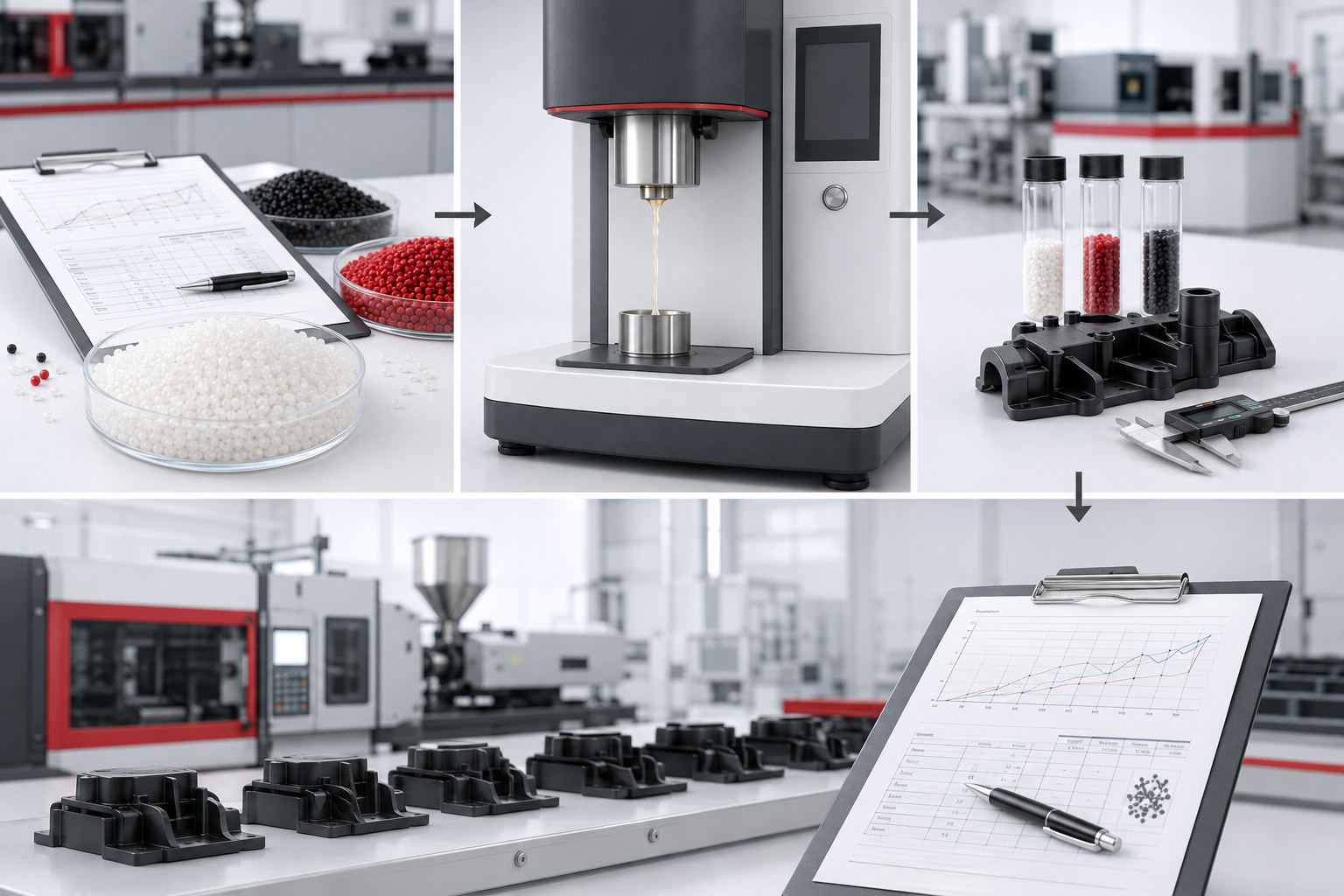
How to determine the right melt flow rate step by step
3. How to select melt flow rate for different processing methods?
3.1. Injection molding
Injection molding prioritizes complete cavity filling. As wall thickness decreases, flow length increases, or the number of cavities rises, manufacturers generally need to consider materials with higher flowability. However, when short shots occur, the gate, runner, temperature, injection speed, and venting system should also be inspected. A low flow rate should not automatically be considered the only cause.
3.2. Extrusion
In extrusion, stable material flow is more important than maximum flow speed. If the melt flow rate is too high, pipes, sheets, or profiles may have difficulty retaining their shape. If it is too low, die pressure, screw torque, and motor load may increase.
Important production parameters include die pressure, motor current, hourly output, and wall-thickness consistency.
3.3. Blown film and blow molding
Blown film requires a balance between melt flow and melt strength. If the material flows too easily, the film bubble may fluctuate, thickness may become uneven, and the risk of film breakage may increase.
In blow molding, the parison must retain its shape before the mold closes. If the melt flow rate is too high, the parison may sag, causing uneven wall-thickness distribution in the finished bottle.
3.4. Plastic compounds
For plastic compounds, manufacturers should use the MFI, MFR, or melt flow rate of the complete formulation. The flow value of the base resin should not be used as the sole reference after the material has been combined with calcium carbonate, talc, glass fiber, pigments, or functional additives.
4. Signs that the melt flow rate may be unsuitable
| Problem |
Possible relationship with flow rate |
Other factors to inspect |
| Short shots |
Flow rate is lower than the product requires |
Small gate, low temperature, poor venting |
| Flash |
Flow rate is too high for the processing window |
Insufficient clamping force, mold wear, excessive pressure |
| Sagging |
Material flows too easily |
Excessive temperature, slow cooling |
| High die pressure |
Flow rate is too low |
Blocked screen pack, narrow die |
| Product-weight variation |
Inconsistent material flow between batches |
Feeding system, non-return valve, temperature variation |
| Unstable film bubble |
Insufficient melt strength |
Uneven cooling, inconsistent haul-off speed |
The table above should only be used for initial diagnosis. The same problem may originate from the material, machine, mold, or process settings. The complete production process should therefore be inspected before changing the raw material.
Technical note: Do not increase temperature, speed, or pressure beyond the limits stated in the technical data sheet and equipment instructions. Excessive adjustments may cause polymer degradation, discoloration, odor, or unstable production.
5. Conclusion
There is no single melt flow rate suitable for every polymer and every processing method. Flow characteristics must be selected based on the resin type, manufacturing process, product design, mechanical requirements, machine capability, and material formulation.
Technical data sheets help manufacturers narrow down potential material options. However, actual production trials and process data remain the most reliable basis for confirming whether a material is suitable for mass production.
The optimum melt flow rate is not necessarily the highest or lowest value. It is the value that allows the material to process consistently, keeps the defect rate under control, and ensures that the finished product meets all performance requirements.
There is no single melt flow rate suitable for every polymer and every processing method.
6. Frequently asked questions about melt flow rate in plastic production
6.1. What is melt flow rate in plastics?
Melt flow rate describes how easily a molten plastic flows under specified test conditions and is commonly expressed as MFI or MFR. It is an important parameter for evaluating processability and selecting suitable plastic materials.
6.2. Is a higher MFI always better?
No. A higher MFI generally means that the material flows more easily, but it is not necessarily suitable for every application. An excessively high MFI may cause flash in injection molding, sagging in extrusion, or unstable film bubbles in blown film production.
6.3. How do you determine the right melt flow rate?
The appropriate melt flow rate should be selected based on the polymer type, processing method, product wall thickness, flow length, mechanical requirements, and machine capability. Technical data sheets can help narrow down the options, while production trials are needed to confirm the final material selection.
6.4. Can MFI values of different plastics be compared directly?
Not necessarily. Before comparing MFI values, manufacturers should check the polymer type, test standard, test temperature, and applied load. Direct comparisons should only be made when the values are measured under comparable conditions.
6.5. Do thin-wall injection molded products require a higher MFI?
In general, thinner walls, longer flow paths, and multi-cavity molds tend to require materials with better flowability. However, gate size, runner design, mold temperature, injection speed, and venting must also be considered before changing the material.
6.6. Can filler masterbatch, color masterbatch, and recycled plastic affect melt flow rate?
Yes. The melt flow rate of the final formulation can be affected by the carrier resin, filler content, particle size, additive system, and recycled material ratio. For plastic compounds, the MFI of the complete formulation should therefore be evaluated rather than relying only on the base resin value.
6.7. What are the signs of an unsuitable melt flow rate?
Possible signs include short shots, flash, sagging, high die pressure, inconsistent product weight, and unstable film bubbles. These problems may also be caused by the machine, mold, or processing conditions, so the entire process should be checked before changing the raw material.
6.8. When should a material trial be repeated?
A material trial should be repeated when changing the raw material source or batch, adjusting filler masterbatch, color masterbatch, or recycled plastic ratios, modifying the formulation, or making significant changes to machine or mold conditions. Trial data helps determine whether the material can maintain a stable processing window.
7. EuroPlas - Material solutions for multiple plastic processing technologies
EuroPlas supplies filler masterbatch, color masterbatch, plastic additives, engineering plastic compounds, and bioplastics for a wide range of processing technologies.
Within each formulation, the carrier resin, filler content, particle size, and additive system can influence dispersion, melt flow rate, mechanical properties, and processing stability. Materials should therefore be selected according to the base resin, manufacturing technology, and final-product requirements.
Contact EuroPlas for support in selecting the appropriate masterbatch, dosage rate, and material formulation for your production line.\
Author: The EuroPlas Team